A page destination identifies where to display a page. A structure destination identifies a logical element, such as a section, whose content determines the page to display. These are separate PDF objects: choosing a semantic target does not require the application to duplicate its page number in every action.
The complete script
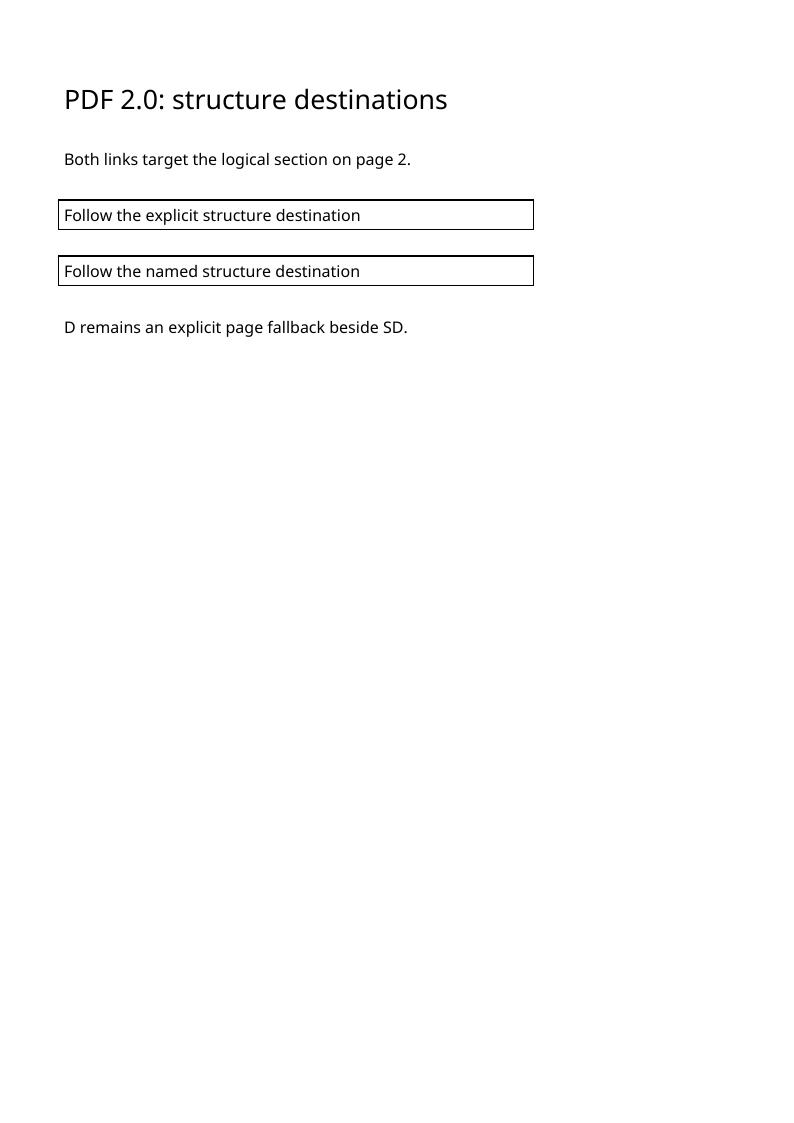
constructs a tagged document with visible internal links, a structure target and
explicit page fallbacks. It also publishes a named destination with an SD entry.
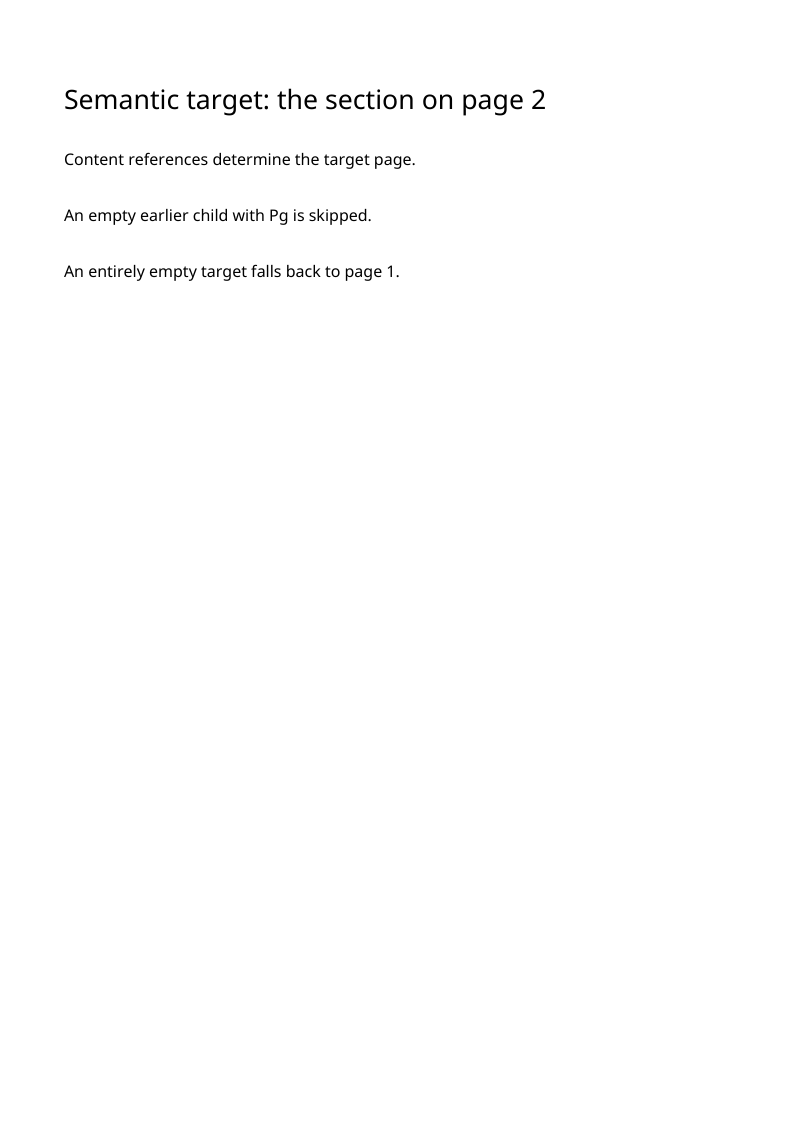
The PDF preview shows the actual pages; support for following SD depends on the viewer.
Run the example
From a core 0.7.1 checkout with its locked development dependencies installed:
php examples/pdf20-structure-destinations.php structure-destinations.pdf
The font program is embedded explicitly. The optional font converter prepares its metrics and Unicode mapping; the core writes the PDF objects. No remote document is opened while constructing these destinations.
Separate the view from its target
DestinationView owns the fit name and its explicit coordinates. It reuses the
existing PDF destination rules: Fit needs no coordinates, while XYZ, FitH,
FitV, FitR, FitB, FitBH and FitBV retain their own arity and null rules.
$view = new DestinationView(new NameType('Fit'));
$destination = new StructureDestination($section, $view);
Here $section is the actual StructureElement, linked into the document's
structure tree. The destination serializes its indirect reference followed by
the view, rather than substituting a page reference or a numeric page index.
Resolve the element's actual page
StructureDestination::page() follows the element's children in their declared
K order. It descends into child elements and finds the first content item with
a page: a marked-content identifier, MCR or object reference. A child element
does not count merely because its dictionary has a Pg entry.
If there is no qualifying content item, the standard falls back to the document's first page. Traversal is bounded and cycles are rejected. The same calculation works against the effective graph of an incremental revision, so an unstaged builder mutation cannot silently change the meaning of retained output.
local() exposes the corresponding local page destination for existing viewport
calculations. It resolves the semantic target explicitly; serialization still
retains the structure destination itself.
This native viewport adapter needs a native PageObject; use page() and the
effective graph directly when the retained page is a frozen generic dictionary.
Supply SD and the fallback deliberately
GoToDestination preserves its existing page destination and accepts a separate
structure: destination. The action writes D and SD independently. A viewer
that understands structure destinations can use SD; the fallback D remains
an ordinary page destination.
StructureDestinationEntry adds SD to a named DestinationDictionary, alongside
its required local fallback. Names, name trees, actions and structure elements
keep their existing object identities. A semantic destination does not create a
second structure tree or invent an element ID.
Keep remote IDs as bytes
RemoteStructureDestination receives an explicit StringType identifier and a
view. Remote and embedded-document actions identify the other document's
structure element through its ID; they do not carry a local object reference.
The library does not fetch that document or assume that its ID exists. Validate
the external file and its identifier in the application that supplies them.
Local graph validation requires PDF 2.0, checks the actual structure-tree member, the view and the destination's context. It also checks generic dictionaries and frozen replacements; replacing a native class does not remove these requirements.
Check the emitted navigation
The independent structure-destination oracle uses pypdf and qpdf to inspect the written actions, named destinations, structure references and page fallbacks. The PHP regressions exercise local and remote forms, traversal order, fallback, invalid contexts and retained revisions. The source is ISO 32000-2:2020 clause 12.3.2.3 and the associated action/destination dictionaries, retained in the original EC3 reference.
Tutorial path · Geospatial objects · Bundle guide
View the PDF result
This file was generated with the code in this documentation. All pages appear below; open the PDF to use its links and bookmarks.
Use the browser PDF viewer
This viewer depends on your browser. If the document does not appear, use “Open the PDF” or “Download”.
Complete source code
Code from roukmoute/pdf · View the source at the documented commit ↗
Read the commented script: pdf20-structure-destinations.php
<?php

declare(strict_types=1);

use PDF\Document\Destinations\Fit;
use PDF\Document\Fonts as Fonts;
use PDF\Document\Navigation as Navigation;
use PDF\Document\ResourceDictionary;
use PDF\Document\Resources\Font;
use PDF\Document\Structure as Structure;
use PDF\FileStructure;
use PDF\Fonts\TrueType as TrueType;
use PDF\Syntax\ContentStreamsResources\ContentStreams;
use PDF\Syntax\ContentStreamsResources\Operators as Op;
use PDF\Syntax\DataStructure\Rectangle;
use PDF\Syntax\DataStructure\TextString;
use PDF\Syntax\DocumentStructure\DocumentCatalog;
use PDF\Syntax\DocumentStructure\PageTree\PageObject;
use PDF\Syntax\DocumentStructure\PageTree\PageTreeNode;
use PDF\Syntax\FileStructure\FileBody;
use PDF\Syntax\FileStructure\FileHeader;
use PDF\Syntax\FileStructure\CrossReferenceFormat;
use PDF\Syntax\Filters\FlateDecode;
use PDF\Syntax\Object\ArrayType;
use PDF\Syntax\Object\BooleanType;
use PDF\Syntax\Object\DictionaryObject\Entry;
use PDF\Syntax\Object\DictionaryType;
use PDF\Syntax\Object\IndirectReference;
use PDF\Syntax\Object\IntegerType;
use PDF\Syntax\Object\NameType;
use PDF\Syntax\Object\NumericType;
use PDF\Syntax\Object\StreamObject;
use PDF\Syntax\Object\StringObject\LiteralString;

require dirname(__DIR__) . '/vendor/autoload.php';

// ISO 32000-2 12.3.2.3 pp.458-459 and Table202 p.526: semantic identity
// and a physical page fallback are deliberately composed as separate objects.
$text = [
    ['PDF 2.0: structure destinations', 'Both links target the logical section on page 2.', 'Follow the explicit structure destination', 'Follow the named structure destination', 'D remains an explicit page fallback beside SD.'],
    ['Semantic target: the section on page 2', 'Content references determine the target page.', 'An empty earlier child with Pg is skipped.', 'An entirely empty target falls back to page 1.'],
];

// The optional converter prepares a real embedded program and mappings. Every
// resulting font, descriptor, CID width and ToUnicode PDF object remains explicit.
$fontBytes = file_get_contents(dirname(__DIR__) . '/vendor/pdftoolkit/pdf-fonts/examples/assets/fonts/NotoSans-Regular.ttf');
if ($fontBytes === false) {
    throw new RuntimeException('Unable to read the demonstration font.');
}
$program = new TrueType\CIDFontProgram(new TrueType\FontProgram($fontBytes));
$fontFile = new Fonts\FontFile2($program->bytes, new FlateDecode());
$map = (new TrueType\CharacterMapFactory($program))->create($fontFile, new TrueType\UnicodeText(implode('', [...$text[0], ...$text[1]])));
$encoder = new TrueType\TextEncoder($map);
$descriptor = (new TrueType\FontDescriptorFactory($program))->create($fontFile, new Fonts\FontDescriptorFlags(4), new NumericType(80));
$font = new Fonts\Type0Font(new Fonts\CIDFontType2($descriptor, new Fonts\CIDToGIDMap($map), new Fonts\CIDWidths($map)), new Fonts\ToUnicodeCMap($map));
$resources = new ResourceDictionary(new Font(new DictionaryType(new Entry(new NameType('F1'), new IndirectReference($font)))));
$namespace = new Structure\StructureNamespace(Structure\StandardStructureNamespace::PDF20);
$role = static fn (string $name): Structure\StructureRole => new Structure\StructureRole(new NameType($name), $namespace);
$content = static function (array $lines, bool $links) use ($encoder): StreamObject {
    $operators = [];
    foreach (array_values($lines) as $index => $line) {
        $operators[] = (new Structure\MarkedContentIdentifier(new IntegerType($index)))->begin(new NameType($index === 0 ? 'H1' : ($links && in_array($index, [2, 3], true) ? 'Link' : 'P')));
        $operators[] = new Op\BeginTextObject();
        $operators[] = new Op\SetTextFontAndSize(new NameType('F1'), new NumericType($index === 0 ? 20 : 12));
        $operators[] = new Op\MoveTextPosition(new NumericType(48), new NumericType(760 - 42 * $index));
        $operators[] = new Op\ShowText($encoder->encode(new TrueType\UnicodeText($line)));
        $operators[] = new Op\EndTextObject();
        $operators[] = new Op\EndMarkedContent();
    }
    return new StreamObject(new ContentStreams(...$operators));
};
$box = new Rectangle(new NumericType(0), new NumericType(0), new NumericType(595), new NumericType(842));
$second = new PageObject($box, $resources, $content($text[1], false), new Entry(new NameType('StructParents'), new IntegerType(1)));
$section = new Structure\StructureElement($role('Sect'));
$view = new Navigation\DestinationView(new NameType('Fit'));
$destination = new Navigation\StructureDestination($section, $view);
$pageFallback = new Navigation\LocalDestination(new Fit($second));
$explicitAction = new Navigation\GoToDestination($pageFallback, structure: $destination);
$namedAction = new Navigation\GoToDestination(new Navigation\NamedDestination(new LiteralString('target-section')));
$annotations = [];
foreach ([$explicitAction, $namedAction] as $position => $action) {
    $annotations[] = new DictionaryType(
        new Entry(new NameType('Type'), new NameType('Annot')),
        new Entry(new NameType('Subtype'), new NameType('Link')),
        new Entry(new NameType('Rect'), new Rectangle(new NumericType(44), new NumericType(670 - 42 * $position), new NumericType(400), new NumericType(692 - 42 * $position))),
        new Entry(new NameType('Border'), new ArrayType(new IntegerType(0), new IntegerType(0), new IntegerType(1))),
        new Entry(new NameType('Contents'), new TextString('Open the semantic section on page 2.')),
        new Entry(new NameType('StructParent'), new IntegerType(100 + $position)),
        new Entry(new NameType('A'), $action),
    );
}
$first = new PageObject($box, $resources, $content($text[0], true), new Entry(new NameType('StructParents'), new IntegerType(0)), new Entry(new NameType('Annots'), new ArrayType(...array_map(static fn (DictionaryType $annotation): IndirectReference => new IndirectReference($annotation), $annotations))), new Entry(new NameType('Tabs'), new NameType('S')));
$pages = (new PageTreeNode())->addKid($first)->addKid($second);
$root = new Structure\StructureTreeRoot($pages, namespaces: new Structure\StructureNamespaces($namespace), inclusionRules: new Structure\StructureInclusionRules());
$document = new Structure\StructureElement($role('Document'));
$root->addKid($document);
$intro = new Structure\StructureElement($role('Sect'));
$document->addKid($intro)->addKid($section);
// An empty Pg entry is intentionally insufficient: the resolver skips this child.
$section->addKid(new Structure\StructureElement($role('P'), page: $first));
foreach ([[$first, $intro, 0], [$second, $section, 1]] as [$page, $parent, $key]) {
    $container = new Structure\MarkedContentContainer($page, new IntegerType($key));
    foreach ($text[$key] as $index => $_line) {
        $link = $key === 0 && in_array($index, [2, 3], true);
        $element = new Structure\StructureElement($role($index === 0 ? 'H1' : ($link ? 'Link' : 'P')), page: $page);
        $element->addKid(new Structure\PageMarkedContent($container, new Structure\MarkedContentIdentifier(new IntegerType($index))));
        if ($link) {
            $element->addKid(new Structure\ObjectReference($page, $annotations[$index - 2], new IntegerType(100 + $index - 2)));
        }
        $parent->addKid($element);
    }
}
$empty = new Structure\StructureElement($role('Sect'), page: $second);
$document->addKid($empty);
$named = new Navigation\NamedDestinations(
    new Navigation\NamedDestinationEntry(new LiteralString('target-section'), new Navigation\DestinationDictionary($pageFallback, new Navigation\StructureDestinationEntry($destination))),
    new Navigation\NamedDestinationEntry(new LiteralString('empty-section'), new Navigation\DestinationDictionary(new Navigation\LocalDestination(new Fit($first)), new Navigation\StructureDestinationEntry(new Navigation\StructureDestination($empty, $view)))),
);
$catalog = new DocumentCatalog($pages, ...[...$root->catalogEntries(new Structure\MarkInformation(new BooleanType(true))), $named->catalogEntry(), new Entry(new NameType('Lang'), new TextString('en-US'))]);
$format = in_array('--xref-stream', $argv ?? [], true) ? CrossReferenceFormat::Stream : (in_array('--hybrid', $argv ?? [], true) ? CrossReferenceFormat::Hybrid : CrossReferenceFormat::Table);
$file = new FileStructure(new FileHeader('2.0'), new FileBody($catalog), new IndirectReference($catalog), crossReferenceFormat: $format);
$path = $argv[1] ?? __DIR__ . '/pdf20-structure-destinations.pdf';
$file->writeTo($path);
echo $path . PHP_EOL;