The complete script writes three pages, two shared fonts, document information and bookmarks. The first page and its dependencies appear near the start of the file.
php examples/linearized.php linearized.pdf
qpdf --check-linearization linearized.pdf
The graph remains explicit: resources, content, pages and catalog are built
before the writer. LinearizedWriter organizes their bytes according to Annex F.
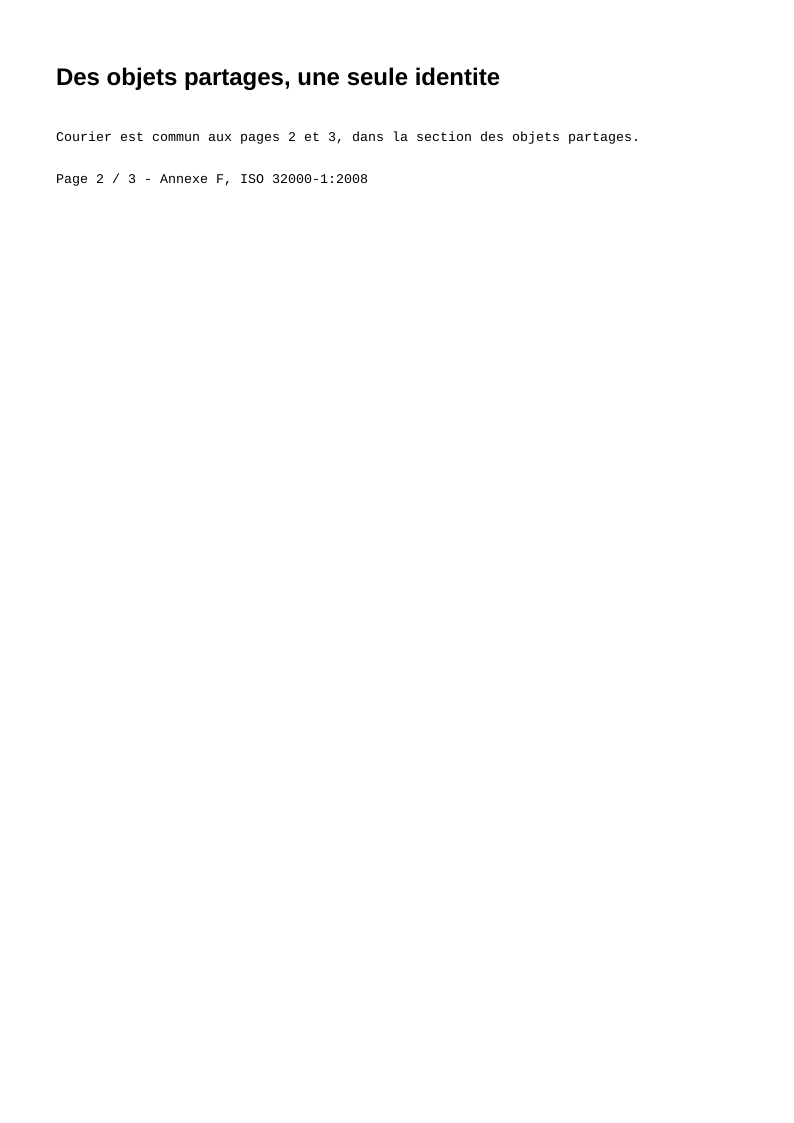
A shared font retains a single identity.
The dictionary declares length /L, first-page object number /O, hint-stream
ranges /H and main-section position /T. These values depend on actual written
bytes. The writer calculates binary hints and offsets using fixed-width fields.
Inherited values become available in page dictionaries. Hints distinguish the first page's resources from objects shared later. The outline and document information have their own ranges too.
Linearization facilitates HTTP byte-range requests; it does not supply an HTTP server. An incremental update invalidates the old file's hints and must be handled separately.
CI compares hints against a binary oracle and qpdf. Annex F permits an initial page other than zero; qpdf's limitation for that variation is reported, and verification uses the separate oracle.
Reference: ISO Annex F, physical pages 683–702.
View the PDF result
This file was generated with the code in this documentation. All pages appear below; open the PDF to use its links and bookmarks.


Use the browser PDF viewer
This viewer depends on your browser. If the document does not appear, use “Open the PDF” or “Download”.
Complete source code
Code from roukmoute/pdf · View the source at the documented commit ↗
Read the commented script: linearized.php
<?php

declare(strict_types=1);

use PDF\Document\Destinations\Fit;
use PDF\Document\DocumentInformation;
use PDF\Document\Fonts\StandardFont;
use PDF\Document\Fonts\Type1Font;
use PDF\Document\Information\Title;
use PDF\Document\OutlineDictionary;
use PDF\Document\OutlineItem;
use PDF\Document\ResourceDictionary;
use PDF\Document\Resources\Font;
use PDF\FileStructure;
use PDF\Serialization\LinearizedWriter;
use PDF\Syntax\ContentStreamsResources\ContentStreams;
use PDF\Syntax\ContentStreamsResources\Operators\BeginTextObject;
use PDF\Syntax\ContentStreamsResources\Operators\EndTextObject;
use PDF\Syntax\ContentStreamsResources\Operators\MoveTextPosition;
use PDF\Syntax\ContentStreamsResources\Operators\SetTextFontAndSize;
use PDF\Syntax\ContentStreamsResources\Operators\ShowText;
use PDF\Syntax\DataStructure\Rectangle;
use PDF\Syntax\DataStructure\TextString;
use PDF\Syntax\DocumentStructure\CatalogDictionary\Outlines;
use PDF\Syntax\DocumentStructure\DocumentCatalog;
use PDF\Syntax\DocumentStructure\PageTree\PageObject;
use PDF\Syntax\DocumentStructure\PageTree\PageTreeNode;
use PDF\Syntax\FileStructure\FileBody;
use PDF\Syntax\FileStructure\FileHeader;
use PDF\Syntax\Object\DictionaryObject\Entry;
use PDF\Syntax\Object\DictionaryType;
use PDF\Syntax\Object\IndirectReference;
use PDF\Syntax\Object\NameType;
use PDF\Syntax\Object\NumericType;
use PDF\Syntax\Object\StreamObject;
use PDF\Syntax\Object\StringObject\LiteralString;

require dirname(__DIR__) . '/vendor/autoload.php';

// 1. The graph retains one identity per font. Helvetica-Bold is used
// on the first page; Courier is shared by the following two.
// These dependencies require two distinct physical locations in the file.
$heading = new Type1Font(StandardFont::HelveticaBold);
$later = new Type1Font(StandardFont::Courier);
$common = new ResourceDictionary(new Font(new DictionaryType(
    new Entry(new NameType('F1'), new IndirectReference($heading)),
)));
$following = new ResourceDictionary(new Font(new DictionaryType(
    new Entry(new NameType('F1'), new IndirectReference($heading)),
    new Entry(new NameType('F2'), new IndirectReference($later)),
)));

// 2. Pages-node values are inherited in the model. Linearization also
// writes them in every Page dictionary: readers can request one page
// without first loading its ancestors in the page tree.
$pages = new PageTreeNode(
    new Entry(new NameType('MediaBox'), new Rectangle(new NumericType(0), new NumericType(0), new NumericType(595), new NumericType(842))),
    new Entry(new NameType('Resources'), new IndirectReference($common)),
);
$leaves = [];
foreach ([
    ['Une premiere page disponible rapidement', 'F1', 'Le catalogue, les indices et cette page arrivent au debut du fichier.'],
    ['Des objets partages, une seule identite', 'F2', 'Courier est commun aux pages 2 et 3, dans la section des objets partages.'],
    ['Deux sections de references croisees', 'F2', 'Le lecteur retrouve aussi les metadonnees et les signets en fin de fichier.'],
] as $index => [$title, $bodyFont, $description]) {
    $content = new StreamObject(new ContentStreams(
        new BeginTextObject(),
        new SetTextFontAndSize(new NameType('F1'), new NumericType(18)),
        new MoveTextPosition(new NumericType(42), new NumericType(778)),
        new ShowText(new LiteralString($title)),
        new SetTextFontAndSize(new NameType($bodyFont), new NumericType(10)),
        new MoveTextPosition(new NumericType(0), new NumericType(-42)),
        new ShowText(new LiteralString($description)),
        new MoveTextPosition(new NumericType(0), new NumericType(-32)),
        new ShowText(new LiteralString('Page ' . ($index + 1) . ' / 3 - Annexe F, ISO 32000-1:2008')),
        new EndTextObject(),
    ));
    $leaf = new PageObject(null, $index === 0 ? null : new IndirectReference($following), $content);
    $pages->addKid($leaf);
    $leaves[] = $leaf;
}

// 3. The outline and information are document objects. They are grouped
// after pages; named hint tables provide their byte ranges.
$outline = new OutlineDictionary();
foreach ($leaves as $index => $leaf) {
    $outline->addItem(new OutlineItem(new TextString('Page ' . ($index + 1)), new Fit($leaf)));
}
$catalog = new DocumentCatalog($pages, new Outlines(new IndirectReference($outline)));
$information = new DocumentInformation(new Title(new TextString('Un document PDF linearise, objet par objet')));
$file = new FileStructure(
    new FileHeader('1.7'),
    new FileBody($catalog),
    new IndirectReference($catalog),
    new DictionaryType(new Entry(new NameType('Info'), new IndirectReference($information)))
);

// 4. The writer calculates order, renumbers references in its own context,
// encodes binary hints and writes exact offsets. The supplied graph remains
// intact; no external program is needed to produce these bytes.
$path = $argv[1] ?? __DIR__ . '/linearized.pdf';
(new LinearizedWriter())->writeTo($file, $path);
echo $path . PHP_EOL;