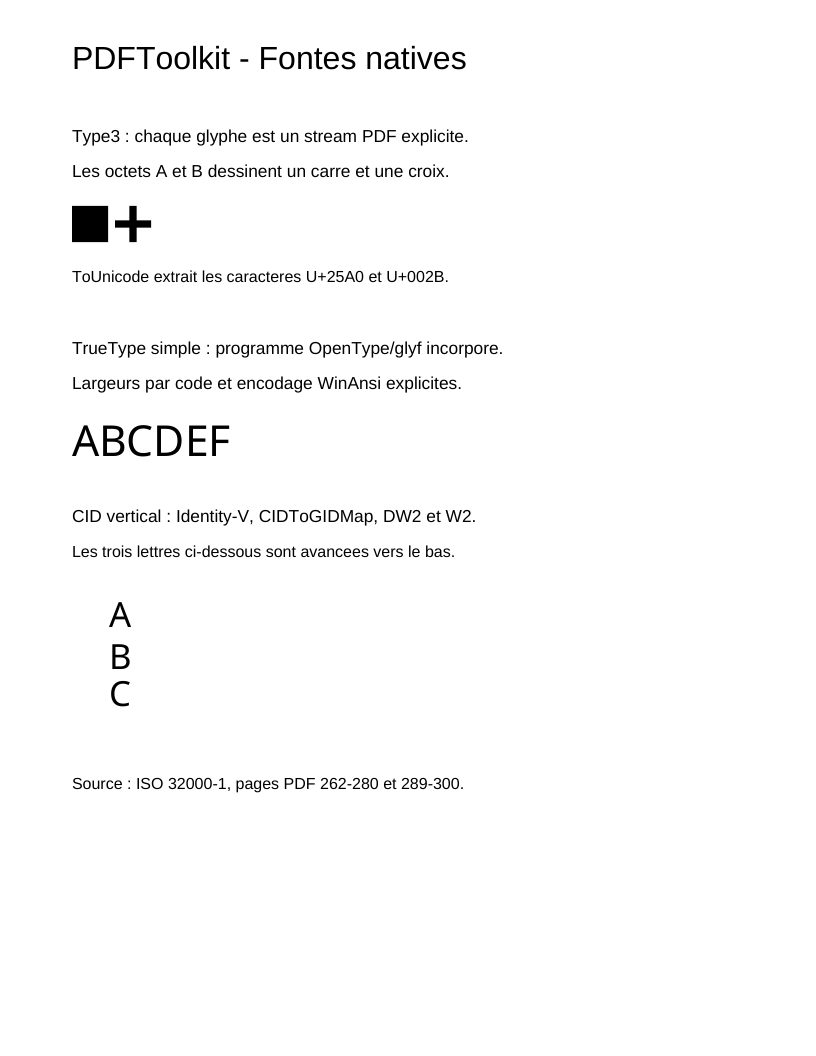
The complete script combines Type3 glyphs drawn with PDF operators, an embedded simple font and a composite font whose metrics position glyphs vertically.
php examples/native-fonts.php native-fonts.pdf
A Type3 font contains CharProcs, each a drawing stream. d0 or d1 declares
its width and, where applicable, its box. Type3CharProcs, EncodingDifferences
and SimpleWidths connect names, codes and metrics. The font matrix transforms
glyph coordinates into text space. The drawing program does not become a layout engine.
A simple font uses one-byte codes, FirstChar, LastChar and corresponding
widths. Its FontDescriptor describes metrics and references an embedded program.
FontFile, FontFile2 and FontFile3 have distinct formats and lengths; the
program is supplied normalized. The script uses the optional module to prepare
TrueType data, then composes them into the core's PDF objects.
A composite font uses CIDs. DW/W supplies horizontal widths; DW2/W2
supplies vertical displacement and origin position. Their range representation
does not expand every CID in memory. Encoding selects vertical mode;
/ToUnicode preserves characters for extraction.
Subset names have a SubsetFontName object and explicit tag. The writer shares
a per-document registry and rejects a collision between distinct programs.
The core neither automatically subsets programs nor shapes complex scripts.
Change Type3 glyphs or vertical metrics to see their roles directly. CI verifies encodings, programs, CID/GID mappings and extracted text with pypdf and Poppler. Some readers classify FontFile3/OpenType with glyf outlines as TrueType; Table 126 permits that declaration, and the example's rendering is checked separately.
Reference: ISO 9.5–9.10, Tables 110–127, physical pages 261–303; Annex D.
View the PDF result
This file was generated with the code in this documentation. All pages appear below; open the PDF to use its links and bookmarks.
Use the browser PDF viewer
This viewer depends on your browser. If the document does not appear, use “Open the PDF” or “Download”.
Complete source code
Code from roukmoute/pdf · View the source at the documented commit ↗
Read the commented script: native-fonts.php
<?php

declare(strict_types=1);

use PDF\Document\Fonts\CIDDefaultVerticalMetrics;
use PDF\Document\Fonts\CIDFontType2;
use PDF\Document\Fonts\CIDGlyphIndex;
use PDF\Document\Fonts\CIDGlyphIndexMap;
use PDF\Document\Fonts\CIDMetrics;
use PDF\Document\Fonts\CIDVerticalMetric;
use PDF\Document\Fonts\CIDVerticalMetrics;
use PDF\Document\Fonts\CIDVerticalRun;
use PDF\Document\Fonts\CIDVerticalWidths;
use PDF\Document\Fonts\CIDWidthArray;
use PDF\Document\Fonts\CIDWidthRun;
use PDF\Document\Fonts\CMaps\CMapCode;
use PDF\Document\Fonts\CMaps\CMapName;
use PDF\Document\Fonts\CMaps\CMapWritingMode;
use PDF\Document\Fonts\CMaps\CodeSpaceRange;
use PDF\Document\Fonts\CMaps\CodeSpaces;
use PDF\Document\Fonts\CMaps\IdentityEncoding;
use PDF\Document\Fonts\CMaps\UnicodeChar;
use PDF\Document\Fonts\CMaps\UnicodeCMap;
use PDF\Document\Fonts\CMaps\UnicodeMappings;
use PDF\Document\Fonts\CMaps\UnicodeScalar;
use PDF\Document\Fonts\Encodings\EncodingDictionary;
use PDF\Document\Fonts\Encodings\EncodingDifference;
use PDF\Document\Fonts\Encodings\EncodingDifferences;
use PDF\Document\Fonts\Encodings\NamedFontEncoding;
use PDF\Document\Fonts\Encodings\PredefinedEncoding;
use PDF\Document\Fonts\FontDescriptor;
use PDF\Document\Fonts\FontDescriptorFlags;
use PDF\Document\Fonts\FontFile2;
use PDF\Document\Fonts\FontFile3;
use PDF\Document\Fonts\FontFile3Subtype;
use PDF\Document\Fonts\FontProgramMetadata;
use PDF\Document\Fonts\OpenTypeOutline;
use PDF\Document\Fonts\SimpleFontMetrics;
use PDF\Document\Fonts\SimpleWidths;
use PDF\Document\Fonts\StandardFont;
use PDF\Document\Fonts\ToUnicodeCMap;
use PDF\Document\Fonts\TrueTypeFont;
use PDF\Document\Fonts\Type0Font;
use PDF\Document\Fonts\Type1Font;
use PDF\Document\Fonts\Type3CharProc;
use PDF\Document\Fonts\Type3CharProcs;
use PDF\Document\Fonts\Type3Font;
use PDF\Document\Fonts\Type3Glyph;
use PDF\Document\ResourceDictionary;
use PDF\Document\Resources\Font;
use PDF\FileStructure;
use PDF\Fonts\TrueType\CIDFontProgram;
use PDF\Fonts\TrueType\FontDescriptorFactory;
use PDF\Fonts\TrueType\FontProgram;
use PDF\Graphics\CoordinateSystems\Matrix;
use PDF\Syntax\ContentStreamsResources\ContentStreams;
use PDF\Syntax\ContentStreamsResources\Operators\AppendRectangle;
use PDF\Syntax\ContentStreamsResources\Operators\BeginTextObject;
use PDF\Syntax\ContentStreamsResources\Operators\EndTextObject;
use PDF\Syntax\ContentStreamsResources\Operators\FillPathNonzero;
use PDF\Syntax\ContentStreamsResources\Operators\MoveTextPosition;
use PDF\Syntax\ContentStreamsResources\Operators\SetGlyphWidthAndBoundingBox;
use PDF\Syntax\ContentStreamsResources\Operators\SetTextFontAndSize;
use PDF\Syntax\ContentStreamsResources\Operators\ShowText;
use PDF\Syntax\ContentStreamsResources\Type3GlyphContentStream;
use PDF\Syntax\DataStructure\Rectangle;
use PDF\Syntax\DocumentStructure\DocumentCatalog;
use PDF\Syntax\DocumentStructure\PageTree\PageObject;
use PDF\Syntax\DocumentStructure\PageTree\PageTreeNode;
use PDF\Syntax\FileStructure\FileBody;
use PDF\Syntax\FileStructure\FileHeader;
use PDF\Syntax\Filters\FlateDecode;
use PDF\Syntax\Object\DictionaryObject\Entry;
use PDF\Syntax\Object\DictionaryType;
use PDF\Syntax\Object\IndirectReference;
use PDF\Syntax\Object\IntegerType;
use PDF\Syntax\Object\NameType;
use PDF\Syntax\Object\NumericType;
use PDF\Syntax\Object\StreamObject;
use PDF\Syntax\Object\StringObject\HexadecimalString;
use PDF\Syntax\Object\StringObject\LiteralString;

require dirname(__DIR__) . '/vendor/autoload.php';

$number = static fn (int|float $value): NumericType => new NumericType($value);
$code = static fn (string $bytes): CMapCode => new CMapCode(new HexadecimalString($bytes));

// A Type3 font contains its own PDF drawing instructions. /CharProcs maps
// each glyph name to an indirect stream; /Differences selects these
// names from bytes 41 and 42. Both d1 operators declare width 600.
// The 0.001 matrix converts glyph coordinates into text space.
$square = new Type3Glyph(new Type3GlyphContentStream(
    new SetGlyphWidthAndBoundingBox($number(600), $number(0), $number(0), $number(0), $number(500), $number(500)),
    new AppendRectangle($number(0), $number(0), $number(500), $number(500)),
    new FillPathNonzero(),
));
$cross = new Type3Glyph(new Type3GlyphContentStream(
    new SetGlyphWidthAndBoundingBox($number(600), $number(0), $number(0), $number(0), $number(500), $number(500)),
    new AppendRectangle($number(200), $number(0), $number(100), $number(500)),
    new FillPathNonzero(),
    new AppendRectangle($number(0), $number(200), $number(500), $number(100)),
    new FillPathNonzero(),
));
$byteSpaces = new CodeSpaces(new CodeSpaceRange($code("\0"), $code("\xff")));
$shapeUnicode = new ToUnicodeCMap(new UnicodeCMap(new CMapName(new NameType('Shapes-UCS')), $byteSpaces, new UnicodeMappings(
    new UnicodeChar($code('A'), (new UnicodeScalar(new IntegerType(0x25A0)))->sequence()),
    new UnicodeChar($code('B'), (new UnicodeScalar(new IntegerType(0x2B)))->sequence()),
)));
$shapes = new Type3Font(
    new Rectangle($number(0), $number(0), $number(500), $number(500)),
    new Matrix(a: $number(0.001), d: $number(0.001)),
    new Type3CharProcs(new Type3CharProc(new NameType('square'), $square), new Type3CharProc(new NameType('cross'), $cross)),
    new EncodingDictionary(new EncodingDifferences(new EncodingDifference(new IntegerType(65), new NameType('square'), new NameType('cross')))),
    new SimpleWidths(new IntegerType(65), $number(600), $number(600)),
    new DictionaryType(),
    toUnicode: $shapeUnicode,
);

// The optional font module reads the external resource. The core receives
// normalized programs and their PDF values: font constructors perform
// no parsing. The simple program retains cmap tables; the normalized
// CID program removes cmap following ISO 9.9.
$bytes = file_get_contents(dirname(__DIR__) . '/vendor/pdftoolkit/pdf-fonts/examples/assets/fonts/NotoSans-Regular.ttf');
if ($bytes === false) {
    throw new RuntimeException('Cannot read the bundled demonstration font.');
}
$source = new FontProgram($bytes);
$cidProgram = new CIDFontProgram($source);
$cidFile = new FontFile2($cidProgram->bytes, new FlateDecode());
$cidDescriptor = (new FontDescriptorFactory($cidProgram))->create($cidFile, new FontDescriptorFlags(4), $number(80));
$metadata = new FontProgramMetadata(new StreamObject('<x:xmpmeta xmlns:x="adobe:ns:meta/"><rdf:RDF xmlns:rdf="http://www.w3.org/1999/02/22-rdf-syntax-ns#"><rdf:Description rdf:about=""/></rdf:RDF></x:xmpmeta>', new DictionaryType(new Entry(new NameType('Type'), new NameType('Metadata')), new Entry(new NameType('Subtype'), new NameType('XML')))));
$simpleFile = new FontFile3($bytes, FontFile3Subtype::OpenType, OpenTypeOutline::Glyf, new FlateDecode(), $metadata);
$box = array_map(static fn (int $value): NumericType => new NumericType($source->metrics->scale($value)), $source->boundingBox);
$simpleDescriptor = new FontDescriptor($simpleFile, new NameType($source->postScriptName), new FontDescriptorFlags(32), new Rectangle(...$box), $number($source->italicAngle), $number($source->metrics->scale($source->ascent)), $number($source->metrics->scale($source->descent)), $number($source->metrics->scale($source->capHeight ?? 700)), $number(80));
$simpleWidths = [];
$cidIndices = [new CIDGlyphIndex(new IntegerType(0), new IntegerType(0))];
$cidWidths = [];
$cidUnicodeMappings = [];
foreach (range(65, 70) as $scalar) {
    $gid = $source->cmap->glyphId($scalar);
    $width = $number($source->metrics->pdfWidth($gid));
    $simpleWidths[] = $width;
    $cid = $scalar - 64;
    $cidIndices[] = new CIDGlyphIndex(new IntegerType($cid), new IntegerType($gid));
    $cidWidths[] = $width;
    $cidUnicodeMappings[] = new UnicodeChar($code(pack('n', $cid)), (new UnicodeScalar(new IntegerType($scalar)))->sequence());
}
$simple = new TrueTypeFont(new NameType($source->postScriptName), new SimpleFontMetrics(new SimpleWidths(new IntegerType(65), ...$simpleWidths), $simpleDescriptor), new NamedFontEncoding(PredefinedEncoding::WinAnsi));

// Vertical mode comes from Identity-V, not the TrueType program. DW2 supplies
// [originY, displacementY] and W2 supplies [displacementY, originX, originY] per CID.
// CIDs 1 and 2 have explicit metrics; others use DW2 and half their
// horizontal width to calculate the default X origin.
$vertical = new CIDVerticalMetrics(new CIDDefaultVerticalMetrics($number(880), $number(-1000)), new CIDVerticalWidths(new CIDVerticalRun(
    new IntegerType(1),
    new CIDVerticalMetric($number(-1200), $number(300), $number(800)),
    new CIDVerticalMetric($number(-1000), $number(300), $number(800)),
)));
$descendant = new CIDFontType2($cidDescriptor, new CIDGlyphIndexMap(...$cidIndices), new CIDMetrics(widths: new CIDWidthArray(new CIDWidthRun(new IntegerType(1), ...$cidWidths)), vertical: $vertical));
$cidUnicode = new ToUnicodeCMap(new UnicodeCMap(new CMapName(new NameType('Vertical-UCS')), new CodeSpaces(new CodeSpaceRange($code("\0\0"), $code("\xff\xff"))), new UnicodeMappings(...$cidUnicodeMappings)));
$verticalFont = new Type0Font($descendant, $cidUnicode, encoding: new IdentityEncoding(CMapWritingMode::Vertical));
$resources = new ResourceDictionary(new Font(new DictionaryType(
    new Entry(new NameType('F1'), new IndirectReference(new Type1Font(StandardFont::Helvetica))),
    new Entry(new NameType('F2'), new IndirectReference($shapes)),
    new Entry(new NameType('F3'), new IndirectReference($simple)),
    new Entry(new NameType('F4'), new IndirectReference($verticalFont)),
)));
$contents = new ContentStreams();
foreach ([['PDFToolkit - Fontes natives', 740, 24], ['Type3 : chaque glyphe est un stream PDF explicite.', 685, 13], ['Les octets A et B dessinent un carre et une croix.', 659, 13], ['ToUnicode extrait les caracteres U+25A0 et U+002B.', 580, 12], ['TrueType simple : programme OpenType/glyf incorpore.', 526, 13], ['Largeurs par code et encodage WinAnsi explicites.', 500, 13], ['CID vertical : Identity-V, CIDToGIDMap, DW2 et W2.', 400, 13], ['Les trois lettres ci-dessous sont avancees vers le bas.', 374, 12], ['Source : ISO 32000-1, pages PDF 262-280 et 289-300.', 200, 12]] as [$text, $y, $size]) {
    $contents = $contents->with(new BeginTextObject(), new SetTextFontAndSize(new NameType('F1'), $number($size)), new MoveTextPosition($number(54), $number($y)), new ShowText(new LiteralString($text)), new EndTextObject());
}
$contents = $contents->with(new BeginTextObject(), new SetTextFontAndSize(new NameType('F2'), $number(54)), new MoveTextPosition($number(54), $number(610)), new ShowText(new HexadecimalString('AB')), new EndTextObject());
$contents = $contents->with(new BeginTextObject(), new SetTextFontAndSize(new NameType('F3'), $number(32)), new MoveTextPosition($number(54), $number(450)), new ShowText(new HexadecimalString('ABCDEF')), new EndTextObject());
$contents = $contents->with(new BeginTextObject(), new SetTextFontAndSize(new NameType('F4'), $number(26)), new MoveTextPosition($number(90), $number(342)), new ShowText(new HexadecimalString("\0\x01\0\x02\0\x03")), new EndTextObject());
$page = new PageObject(new Rectangle($number(0), $number(0), $number(612), $number(792)), $resources, new StreamObject($contents));
$pages = (new PageTreeNode())->addKid($page);
$catalog = new DocumentCatalog($pages);
$file = new FileStructure(new FileHeader('1.7'), new FileBody($catalog), new IndirectReference($catalog));
$path = $argv[1] ?? __DIR__ . '/native-fonts.pdf';
$file->writeTo($path);
echo 'PDF written to ' . $path . PHP_EOL;