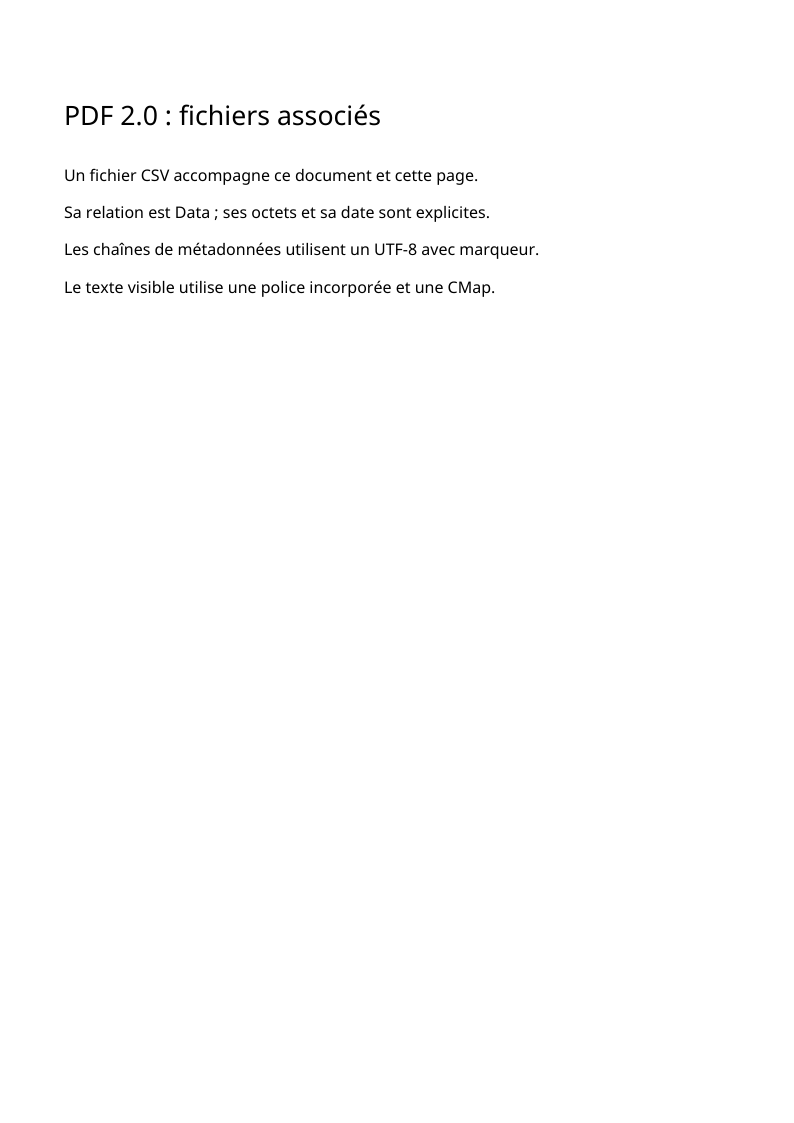
The complete script generates a PDF 2.0 page with an embedded font, Unicode metadata and an embedded CSV. The CSV is associated with the document and page, and a named MCAF property list links marked content to the file. These are actual PDF objects, not only a filename drawn on a page.
Run the example
From a core 0.6.2 checkout with its locked development dependencies:
php examples/pdf20-associated-files.php pdf20-associated-files.pdf
PHP 8.3 or later and the optional pdftoolkit/pdf-fonts module are used. The
checkout installs that module for examples; normal core installation does not.
The build runs this script and renders its pages. The preview below comes from
that actual PDF; download it to inspect associated files in a capable reader.
Encode visible text and metadata separately
Dictionary metadata uses TextString with Utf8TextStringEncoding, which
writes a UTF-8 BOM before the encoded value. This is a PDF 2.0 text-string
mechanism. The example retains the deprecated Info.Title entry solely to
demonstrate that encoding; it does not claim complete PDF 2.0 conformance.
It allows metadata outside the PDFDocEncoding character set without
pretending that the original UTF-8 bytes are already font codes.
Visible page text follows a separate path. The example reads the demonstration Noto Sans font with the optional font converter, embeds its PDF font program, selects a font resource and supplies CID character codes to text operators. The ToUnicode CMap maps those codes back to Unicode. These objects continue to matter even when the file's metadata uses UTF-8.
Supply and describe the CSV
The application supplies the CSV bytes to EmbeddedFileStream, with a text/csv
MIME name and source modification date 2026-10-14T00:00:00Z. Its PDF filename
is F (donnees.csv) with the preferred Unicode UF name données.csv.
Both EF.F and EF.UF point to the same stream. EmbeddedFileBindings connects an indirect stream reference to the
file specification's EF dictionary. Its name and description remain explicit
PDF values; the core does not fetch an external file or interpret its CSV rows.
AssociatedFileRelationship adds AFRelationship /Data, declaring the CSV's
relationship to the PDF presentation. The relationship describes semantics,
not a command to execute the embedded file. Size/checksum metadata describes
bytes and does not prove their origin or safety.
Connect the document, page and marked content
AssociatedFiles holds the file specifications and AssociatedFilesEntry
writes /AF on the document catalog and page. These owners reuse the same
file specification rather than inventing independent copies of the attachment.
An attachment name tree can make the file discoverable separately from its
association with those owners.
The marked-content association uses a named Resources.Properties dictionary
containing /MCAF under AFData, followed by /AF /AFData BDC … EMC in the content stream.
The corrected EC3 model keeps the property list a dictionary. It also keeps
indirect stream references outside content-stream syntax. A direct array after
BDC, an empty association or a file without AFRelationship fails native
validation on supported associations; DP/MP cannot replace the sequence.
Select the PDF 2.0 catalog
The example uses the edition-specific CatalogDictionaryTable29 schema and an
explicit PDF 2.0 FileHeader. The catalog requires Type /Catalog and its page
tree reference; the selected edition records EC3 independently of output version.
UTF-8 metadata and AF/MCAF require PDF 2.0 and are checked against the effective
version, including catalog overrides and effective revision objects.
The ISO1 table number 29 describes a page-tree node; it must not be substituted for this ISO2 catalog. A new header alone does not implement all PDF 2.0 rules.
Inspect the PDF and keep its limits visible
Open the downloaded document in a reader supporting embedded/associated files.
Inspect the catalog and page /AF, file specification /AFRelationship /Data,
embedded stream bytes, named property dictionary /MCAF, PDF 2.0 header and
UTF-8 metadata. Compare visible text with the embedded font and ToUnicode mapping.
Independent checks exercise those bytes and references rather than only accepting
a successful generation call.
The optional pdf-reader package still documents PDF 1.0–1.7 reading. The example
uses external validation tools for PDF 2.0. This lesson does not encrypt the file
and does not implement R=6, native namespaces, DSS/timestamps, document parts or
full ISO 32000-2 conformance.
References
The PDF 2.0 guide explains editions, applicability and remaining mechanisms. Physical source pages: text strings 131–132; catalog 113–117; file specifications 149–152; associated files 853–856; corrected MCAF table 409a 1015. The original is preserved unchanged in the public core repository. See also official sponsored access and the public erratum 374.
View the PDF result
This file was generated with the code in this documentation. All pages appear below; open the PDF to use its links and bookmarks.
Use the browser PDF viewer
This viewer depends on your browser. If the document does not appear, use “Open the PDF” or “Download”.
Complete source code
Code from roukmoute/pdf · View the source at the documented commit ↗
Read the commented script: pdf20-associated-files.php
<?php

declare(strict_types=1);

use PDF\Document\Files\AFRelationship;
use PDF\Document\Files\AssociatedFileRelationship;
use PDF\Document\Files\AssociatedFiles;
use PDF\Document\Files\AssociatedFilesPropertyList;
use PDF\Document\Files\BeginAssociatedFilesMarkedContent;
use PDF\Document\Files\EmbeddedFileBinding;
use PDF\Document\Files\EmbeddedFileBindings;
use PDF\Document\Files\EmbeddedFileKey;
use PDF\Document\Files\EmbeddedFileStream;
use PDF\Document\Files\FileSpecification;
use PDF\Document\Files\FileSpecificationOptions;
use PDF\Document\Files\FileSpecificationName;
use PDF\Document\Fonts\CIDFontType2;
use PDF\Document\Fonts\CIDToGIDMap;
use PDF\Document\Fonts\CIDWidths;
use PDF\Document\Fonts\FontDescriptorFlags;
use PDF\Document\Fonts\FontFile2;
use PDF\Document\Fonts\ToUnicodeCMap;
use PDF\Document\Fonts\Type0Font;
use PDF\Document\ResourceDictionary;
use PDF\Document\Resources\Font;
use PDF\Document\Resources\Properties;
use PDF\FileStructure;
use PDF\Fonts\TrueType\CharacterMapFactory;
use PDF\Fonts\TrueType\CIDFontProgram;
use PDF\Fonts\TrueType\FontDescriptorFactory;
use PDF\Fonts\TrueType\FontProgram;
use PDF\Fonts\TrueType\TextEncoder;
use PDF\Fonts\TrueType\UnicodeText;
use PDF\Specification\Iso32000_2\Dictionary\CatalogDictionaryTable29;
use PDF\Specification\Iso32000_2\Dictionary\CatalogDictionaryTable29\AFEntry;
use PDF\Specification\Iso32000_2\Dictionary\CatalogDictionaryTable29\PagesEntry;
use PDF\Specification\Iso32000_2\Dictionary\CatalogDictionaryTable29\TypeEntry;
use PDF\Syntax\ContentStreamsResources\ContentStreams;
use PDF\Syntax\ContentStreamsResources\Operators as Op;
use PDF\Syntax\DataStructure\Date;
use PDF\Syntax\DataStructure\Rectangle;
use PDF\Syntax\DataStructure\TextString;
use PDF\Syntax\DataStructure\Utf8TextStringEncoding;
use PDF\Syntax\DocumentStructure\PageTree\PageObject;
use PDF\Syntax\DocumentStructure\PageTree\PageTreeNode;
use PDF\Syntax\FileStructure\FileBody;
use PDF\Syntax\FileStructure\FileHeader;
use PDF\Syntax\FileStructure\PdfVersion;
use PDF\Syntax\Filters\FlateDecode;
use PDF\Syntax\Object\DictionaryObject\Entry;
use PDF\Syntax\Object\DictionaryType;
use PDF\Syntax\Object\IndirectReference;
use PDF\Syntax\Object\NameType;
use PDF\Syntax\Object\NumericType;
use PDF\Syntax\Object\StreamObject;
use PDF\Syntax\Object\StringObject\LiteralString;

require dirname(__DIR__) . '/vendor/autoload.php';

// Text strings in metadata and filenames use PDF2's UTF8 BOM. This is not a
// font encoding: text-showing operators below still receive explicit CID codes.
$utf8 = new Utf8TextStringEncoding();
$title = new TextString('PDF 2.0 : fichiers associés', $utf8);
$csv = "produit,quantite,prix_unitaire\nPapier,2,3.50\nEnveloppes,4,1.20\n";
$payload = new EmbeddedFileStream(
    $csv,
    new NameType('text/csv'),
    modificationDate: new Date(new DateTimeImmutable('2026-10-14T00:00:00+00:00')),
    filters: new FlateDecode(),
);
$specification = new FileSpecification(
    new LiteralString('donnees.csv'),
    new FileSpecificationOptions(
        embedded: new EmbeddedFileBindings(new EmbeddedFileBinding(EmbeddedFileKey::File, $payload), new EmbeddedFileBinding(EmbeddedFileKey::UnicodeFile, $payload)),
        description: new TextString('Données source de cette page.', $utf8),
        additionalNames: new FileSpecificationName(EmbeddedFileKey::UnicodeFile, new TextString('données.csv', $utf8)),
    ),
    new AssociatedFileRelationship(AFRelationship::Data),
);
// The same indirect identity is associated with both the document and its page.
// /AF expresses a relationship; it is distinct from the EmbeddedFiles name tree.
$files = new AssociatedFiles(new IndirectReference($specification));

$lines = [
    new UnicodeText('PDF 2.0 : fichiers associés'),
    new UnicodeText('Un fichier CSV accompagne ce document et cette page.'),
    new UnicodeText('Sa relation est Data ; ses octets et sa date sont explicites.'),
    new UnicodeText('Les chaînes de métadonnées utilisent un UTF-8 avec marqueur.'),
    new UnicodeText('Le texte visible utilise une police incorporée et une CMap.'),
];
// Font conversion remains optional and outside the core. Its distributed fixture
// supplies a complete font program; each PDF font/CID/Unicode object is explicit.
$fontBytes = file_get_contents(dirname(__DIR__) . '/vendor/pdftoolkit/pdf-fonts/examples/assets/fonts/NotoSans-Regular.ttf');
if ($fontBytes === false) {
    throw new RuntimeException('Unable to read the bundled demonstration font.');
}
$program = new CIDFontProgram(new FontProgram($fontBytes));
$fontFile = new FontFile2($program->bytes, new FlateDecode());
$repertoire = new UnicodeText(implode('', array_map(static fn (UnicodeText $line): string => $line->utf8, $lines)));
$map = (new CharacterMapFactory($program))->create($fontFile, $repertoire);
$encoder = new TextEncoder($map);
$descriptor = (new FontDescriptorFactory($program))->create($fontFile, new FontDescriptorFlags(4), new NumericType(80));
$descendant = new CIDFontType2($descriptor, new CIDToGIDMap($map, new FlateDecode()), new CIDWidths($map));
$font = new Type0Font($descendant, new ToUnicodeCMap($map, new FlateDecode()));
// MCAF associates a content sequence through a named property dictionary.
$resources = new ResourceDictionary(
    new Font(new DictionaryType(new Entry(new NameType('F1'), new IndirectReference($font)))),
    new Properties(new DictionaryType(new Entry(new NameType('AFData'), new AssociatedFilesPropertyList($files)))),
);
$operators = [new BeginAssociatedFilesMarkedContent(new NameType('AFData')), new Op\BeginTextObject(), new Op\SetTextFontAndSize(new NameType('F1'), new NumericType(20)), new Op\MoveTextPosition(new NumericType(48), new NumericType(748))];
foreach ($lines as $index => $line) {
    if ($index !== 0) {
        $operators[] = new Op\SetTextFontAndSize(new NameType('F1'), new NumericType(12));
        $operators[] = new Op\MoveTextPosition(new NumericType(0), new NumericType($index === 1 ? -42 : -28));
    }
    $operators[] = new Op\ShowText($encoder->encode($line));
}
$operators[] = new Op\EndTextObject();
$operators[] = new Op\EndMarkedContent();
$page = new PageObject(
    new Rectangle(new NumericType(0), new NumericType(0), new NumericType(595), new NumericType(842)),
    $resources,
    new StreamObject(new ContentStreams(...$operators)),
    new Entry(new NameType('AF'), $files),
);
$pages = (new PageTreeNode())->addKid($page);
// This definition belongs to ISO32000-2 Table29, separately from ISO32000-1 Table28.
$catalog = new CatalogDictionaryTable29(new TypeEntry(new NameType('Catalog')), new PagesEntry(new IndirectReference($pages)), new AFEntry($files));
// Info is retained for a simple UTF8 string demonstration. It is deprecated in
// PDF2.0; this example does not claim complete PDF2.0 or archival-profile conformance.
$info = new DictionaryType(new Entry(new NameType('Title'), $title));
$file = new FileStructure(new FileHeader(PdfVersion::PDF20), new FileBody($catalog), trailerEntries: new DictionaryType(new Entry(new NameType('Info'), new IndirectReference($info))));
$path = $argv[1] ?? __DIR__ . '/pdf20-associated-files.pdf';
$file->writeTo($path);
echo $path . PHP_EOL;