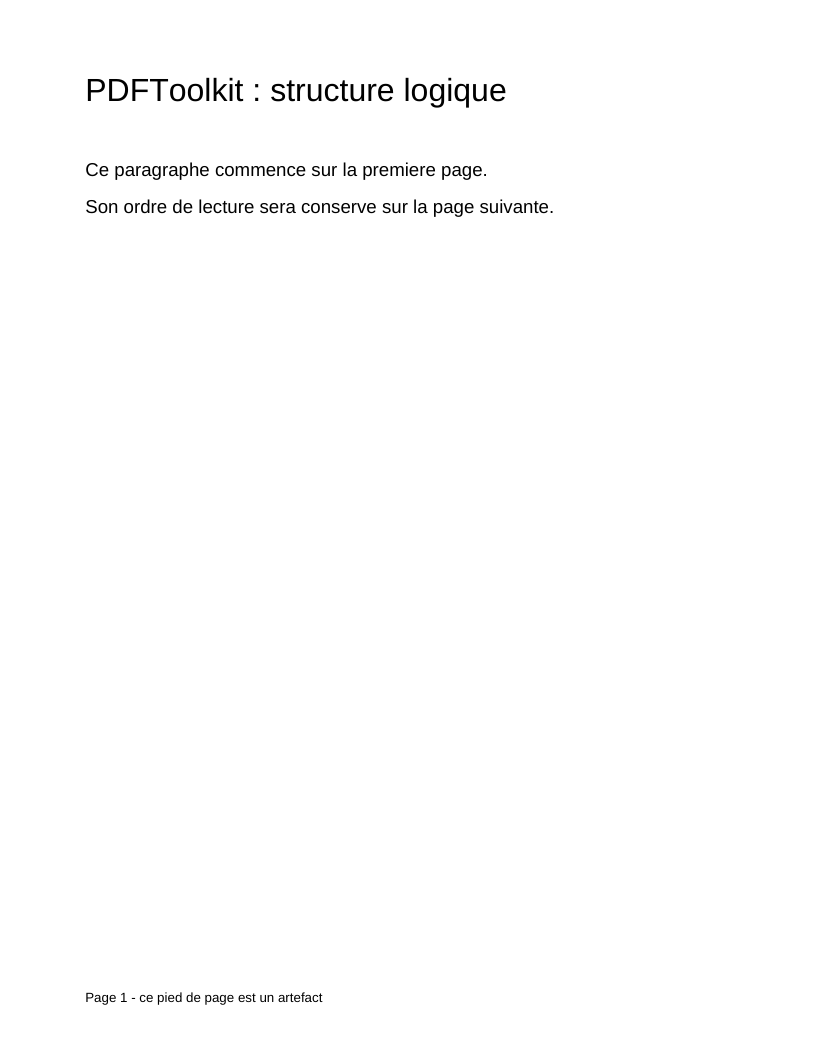
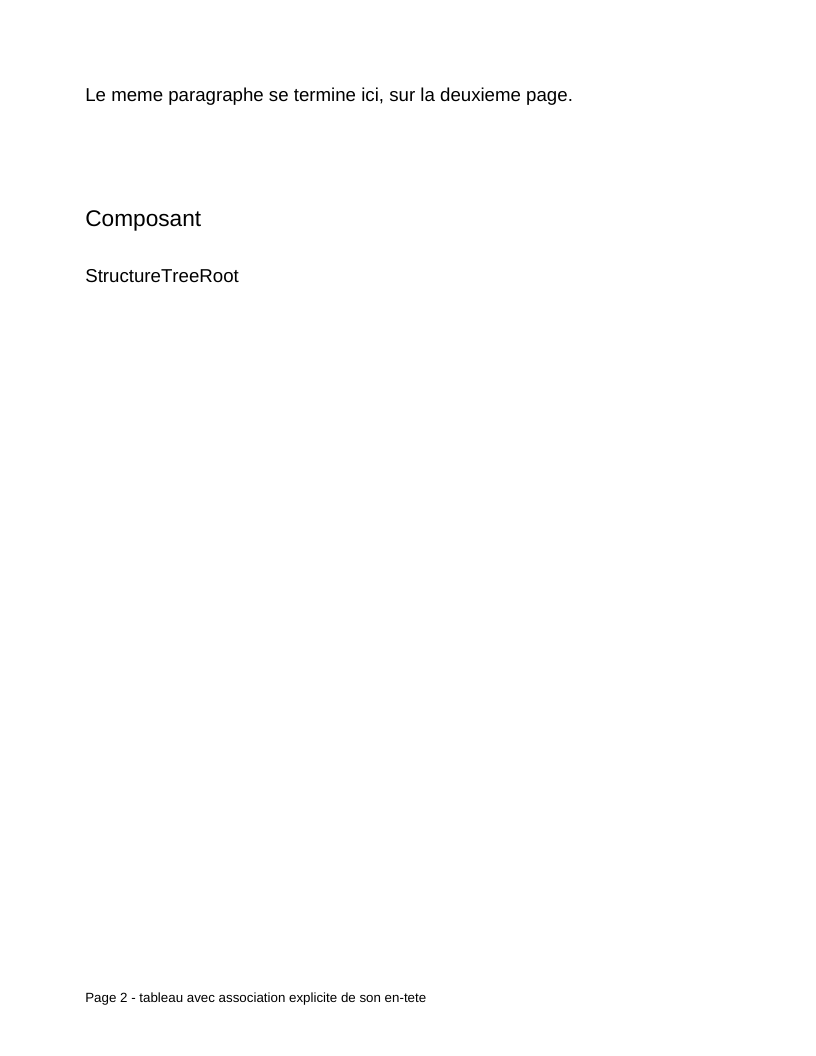
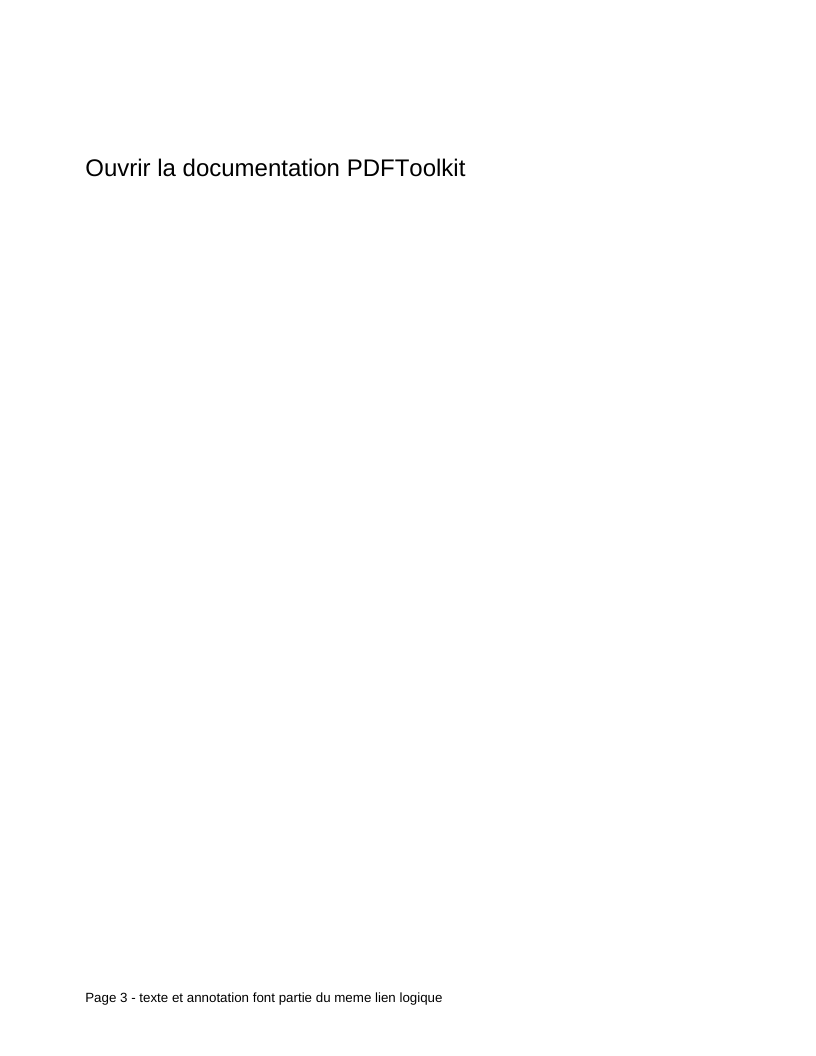
The complete script builds three pages: a title, a paragraph continuing onto the second page, a table with an identified header, and a link associating its text with its annotation.
php examples/tagged-structure.php tagged-structure.pdf
Operators draw visible content. A BDC/EMC sequence assigns an MCID to a
portion of content. This integer is local to its container; another page can
have the same integer. Multiple /Contents streams on one page are read in
order, even when a sequence begins in one and ends in another.
StructureTreeRoot and StructureElement compose logical reading order
independently of positions. /K children can be other elements, page content,
an MCR specifying another page or an OBJR to an annotation. The example uses
an MCR for the continuing paragraph and an OBJR for the link's interactive area.
ParentTree establishes reverse links from StructParents and StructParent.
IDTree identifies the table header; the cell's Headers uses that identifier.
ClassMap shares attributes while retaining revisions specific to each association.
Footers are artifacts. Language fr-FR and MarkInfo.Marked declare the chosen
conventions. Objects check roles, associations and identities; reading-order
quality and alternatives remain editorial responsibilities. This example is
not a PDF/UA certification.
Changing MCIDs, page links or header identifiers shows why these values depend on the entire graph.
Reference: ISO 14.7–14.9, physical pages 564–628.
View the PDF result
This file was generated with the code in this documentation. All pages appear below; open the PDF to use its links and bookmarks.
Use the browser PDF viewer
This viewer depends on your browser. If the document does not appear, use “Open the PDF” or “Download”.
Complete source code
Code from roukmoute/pdf · View the source at the documented commit ↗
Read the commented script: tagged-structure.php
<?php

declare(strict_types=1);

use PDF\Document\Fonts\StandardFont;
use PDF\Document\Fonts\Type1Font;
use PDF\Document\ResourceDictionary;
use PDF\Document\Resources\Font;
use PDF\Document\Structure\AttributeAssociation;
use PDF\Document\Structure\AttributeClass;
use PDF\Document\Structure\AttributeClassAssociation;
use PDF\Document\Structure\AttributeClassAssociations;
use PDF\Document\Structure\ClassMap;
use PDF\Document\Structure\MarkInformation;
use PDF\Document\Structure\MarkedContentContainer;
use PDF\Document\Structure\MarkedContentIdentifier;
use PDF\Document\Structure\MarkedContentReference;
use PDF\Document\Structure\ObjectReference;
use PDF\Document\Structure\PageMarkedContent;
use PDF\Document\Structure\PageContentSequence;
use PDF\Document\Structure\RoleMap;
use PDF\Document\Structure\StandardStructureType;
use PDF\Document\Structure\StructureAttributeObject;
use PDF\Document\Structure\StructureAttributes;
use PDF\Document\Structure\StructureElement;
use PDF\Document\Structure\StructureTreeRoot;
use PDF\FileStructure;
use PDF\Specification\Dictionary\LinkAnnotationTable173;
use PDF\Specification\Dictionary\URIActionTable206;
use PDF\Syntax\ContentStreamsResources\ContentStreams;
use PDF\Syntax\ContentStreamsResources\Operator;
use PDF\Syntax\ContentStreamsResources\Operators\BeginMarkedContent;
use PDF\Syntax\ContentStreamsResources\Operators\BeginTextObject;
use PDF\Syntax\ContentStreamsResources\Operators\EndMarkedContent;
use PDF\Syntax\ContentStreamsResources\Operators\EndTextObject;
use PDF\Syntax\ContentStreamsResources\Operators\MoveTextPosition;
use PDF\Syntax\ContentStreamsResources\Operators\SetTextFontAndSize;
use PDF\Syntax\ContentStreamsResources\Operators\ShowText;
use PDF\Syntax\DataStructure\Rectangle;
use PDF\Syntax\DataStructure\TextString;
use PDF\Syntax\DocumentStructure\CatalogDictionary\Lang;
use PDF\Syntax\DocumentStructure\DocumentCatalog;
use PDF\Syntax\DocumentStructure\PageTree\PageObject;
use PDF\Syntax\DocumentStructure\PageTree\PageTreeNode;
use PDF\Syntax\FileStructure\FileBody;
use PDF\Syntax\FileStructure\FileHeader;
use PDF\Syntax\Object\ArrayType;
use PDF\Syntax\Object\BooleanType;
use PDF\Syntax\Object\DictionaryObject\Entry;
use PDF\Syntax\Object\DictionaryType;
use PDF\Syntax\Object\IndirectReference;
use PDF\Syntax\Object\IntegerType;
use PDF\Syntax\Object\NameType;
use PDF\Syntax\Object\StreamObject;
use PDF\Syntax\Object\StringObject\LiteralString;

require dirname(__DIR__) . '/vendor/autoload.php';

// ISO 32000-1, 14.7-14.8: logical structure and page drawing are
// separate graphs. Their associations remain explicit objects.
$font = new Type1Font(StandardFont::Helvetica, new Entry(new NameType('Encoding'), new NameType('WinAnsiEncoding')));
$resources = new ResourceDictionary(new Font(new DictionaryType(new Entry(new NameType('F1'), new IndirectReference($font)))));
$box = new Rectangle(new IntegerType(0), new IntegerType(0), new IntegerType(612), new IntegerType(792));

// These local functions only draw text. Tagging is supplied separately
// by MCID objects: no layout engine decides meaning.
/** @return list<Operator> */
$line = static fn (string $text, int $y, int $size = 14): array => [
    new BeginTextObject(),
    new SetTextFontAndSize(new NameType('F1'), new IntegerType($size)),
    new MoveTextPosition(new IntegerType(64), new IntegerType($y)),
    new ShowText(new LiteralString($text)),
    new EndTextObject(),
];
/** @return list<Operator> */
$footer = static fn (string $text): array => [
    new BeginMarkedContent(new NameType('Artifact')),
    ...$line($text, 40, 10),
    new EndMarkedContent(),
];

$headingId = new MarkedContentIdentifier(new IntegerType(0));
$paragraphStartId = new MarkedContentIdentifier(new IntegerType(1));
$paragraphEndId = new MarkedContentIdentifier(new IntegerType(0));
$headerId = new MarkedContentIdentifier(new IntegerType(1));
$cellId = new MarkedContentIdentifier(new IntegerType(2));
$linkId = new MarkedContentIdentifier(new IntegerType(0));

// The MCID identifier is local to page content. MCID 0 can therefore
// be used on three pages through three different StructParents keys.
$page1Contents = new PageContentSequence(new ContentStreams(...[
    $headingId->begin(StandardStructureType::H1),
    ...$line('PDFToolkit : structure logique', 716, 24),
    new EndMarkedContent(),
    $paragraphStartId->begin(StandardStructureType::P),
    ...$line('Ce paragraphe commence sur la premiere page.', 660),
]), new ContentStreams(...[
    // Both Contents streams are considered one page stream:
    // this second fragment ends the MCID 1 sequence opened in the first.
    ...$line('Son ordre de lecture sera conserve sur la page suivante.', 632),
    new EndMarkedContent(),
    ...$footer('Page 1 - ce pied de page est un artefact'),
]));
$page1 = new PageObject($box, $resources, $page1Contents->contents(), new Entry(new NameType('StructParents'), new IntegerType(0)));
$page2 = new PageObject($box, $resources, new StreamObject(new ContentStreams(...[
    $paragraphEndId->begin(StandardStructureType::P),
    ...$line('Le meme paragraphe se termine ici, sur la deuxieme page.', 716),
    new EndMarkedContent(),
    $headerId->begin(StandardStructureType::TH),
    ...$line('Composant', 622, 17),
    new EndMarkedContent(),
    $cellId->begin(StandardStructureType::TD),
    ...$line('StructureTreeRoot', 580),
    new EndMarkedContent(),
    ...$footer('Page 2 - tableau avec association explicite de son en-tete'),
])), new Entry(new NameType('StructParents'), new IntegerType(1)));

// The visible link and its interactive area are separate objects. OBJR attaches
// both to the same Link element; StructParent is a fourth ParentTree key.
$annotation = new LinkAnnotationTable173(
    new Entry(new NameType('Type'), new NameType('Annot')),
    new Entry(new NameType('Subtype'), new NameType('Link')),
    new Entry(new NameType('Rect'), new Rectangle(new IntegerType(64), new IntegerType(650), new IntegerType(460), new IntegerType(676))),
    new Entry(new NameType('Border'), new ArrayType(new IntegerType(0), new IntegerType(0), new IntegerType(0))),
    new Entry(new NameType('StructParent'), new IntegerType(3)),
    new Entry(new NameType('A'), new URIActionTable206(
        new Entry(new NameType('S'), new NameType('URI')),
        new Entry(new NameType('URI'), new LiteralString('https://pdftoolkit.github.io/pdf/')),
    )),
);
$page3 = new PageObject($box, $resources, new StreamObject(new ContentStreams(...[
    $linkId->begin(StandardStructureType::Link),
    ...$line('Ouvrir la documentation PDFToolkit', 660, 18),
    new EndMarkedContent(),
    ...$footer('Page 3 - texte et annotation font partie du meme lien logique'),
])), new Entry(new NameType('StructParents'), new IntegerType(2)), new Entry(new NameType('Annots'), new ArrayType(new IndirectReference($annotation))));
$pages = (new PageTreeNode())->addKid($page1)->addKid($page2)->addKid($page3);
$scope1 = new MarkedContentContainer($page1, new IntegerType(0));
$scope2 = new MarkedContentContainer($page2, new IntegerType(1));
$scope3 = new MarkedContentContainer($page3, new IntegerType(2));

// ClassMap shares an attribute value. Revisions remain specific to element
// associations; they are never placed in the shared attribute.
$normal = new AttributeClass(new NameType('Normal'), new StructureAttributeObject(new DictionaryType(
    new Entry(new NameType('O'), new NameType('Layout')),
    new Entry(new NameType('TextAlign'), new NameType('Start')),
)));
$root = new StructureTreeRoot($pages, new RoleMap(), new ClassMap($normal));
$document = new StructureElement(StandardStructureType::Document);
$heading = (new StructureElement(StandardStructureType::H1, $page1, new LiteralString('heading')))->addKid(new PageMarkedContent($scope1, $headingId));
$paragraph = new StructureElement(StandardStructureType::P, $page1, new LiteralString('paragraph'), classes: new AttributeClassAssociations(new AttributeClassAssociation(new NameType('Normal'))));
$paragraph->addKid(new PageMarkedContent($scope1, $paragraphStartId));
// The full MCR form identifies the second page without changing the paragraph's Pg.
$paragraph->addKid(new MarkedContentReference($scope2, $paragraphEndId));
$table = new StructureElement(StandardStructureType::Table, $page2, new LiteralString('components'), new StructureAttributes(
    new AttributeAssociation(new StructureAttributeObject(new DictionaryType(new Entry(new NameType('O'), new NameType('Layout')), new Entry(new NameType('BBox'), new Rectangle(new IntegerType(64), new IntegerType(575), new IntegerType(450), new IntegerType(645)))))),
    new AttributeAssociation(new StructureAttributeObject(new DictionaryType(new Entry(new NameType('O'), new NameType('Table')), new Entry(new NameType('Summary'), new TextString('Liste des composants PDF'))))),
));
$header = new StructureElement(StandardStructureType::TH, $page2, new LiteralString('component-header'), new StructureAttributes(new AttributeAssociation(new StructureAttributeObject(new DictionaryType(new Entry(new NameType('O'), new NameType('Table')), new Entry(new NameType('Scope'), new NameType('Column')))))));
$header->addKid(new PageMarkedContent($scope2, $headerId));
$cell = new StructureElement(StandardStructureType::TD, $page2, attributes: new StructureAttributes(new AttributeAssociation(new StructureAttributeObject(new DictionaryType(new Entry(new NameType('O'), new NameType('Table')), new Entry(new NameType('Headers'), new ArrayType(new LiteralString('component-header'))))))));
$cell->addKid(new PageMarkedContent($scope2, $cellId));
$table->addKid((new StructureElement(StandardStructureType::TR))->addKid($header));
$table->addKid((new StructureElement(StandardStructureType::TR))->addKid($cell));
$link = (new StructureElement(StandardStructureType::Link, $page3, new LiteralString('documentation-link')))->addKid(new PageMarkedContent($scope3, $linkId))->addKid(new ObjectReference($page3, $annotation, new IntegerType(3)));
$root->addKid($document->addKid($heading)->addKid($paragraph)->addKid($table)->addKid($link));

// This validation builds P/K, IDTree and ParentTree, checks their links,
// then verifies Tagged PDF structural conventions. Word choice, Unicode,
// layout and reading order remain explicit.
$catalog = new DocumentCatalog($pages, new Lang(new TextString('fr-FR')), ...$root->catalogEntries(new MarkInformation(new BooleanType(true))));
$file = new FileStructure(new FileHeader('1.7'), new FileBody($catalog), new IndirectReference($catalog));
$path = $argv[1] ?? __DIR__ . '/tagged-structure.pdf';
$file->writeTo($path);
echo 'PDF written to ' . $path . PHP_EOL;