Module optionnel · pdftoolkit/html-to-pdf 0.4.0
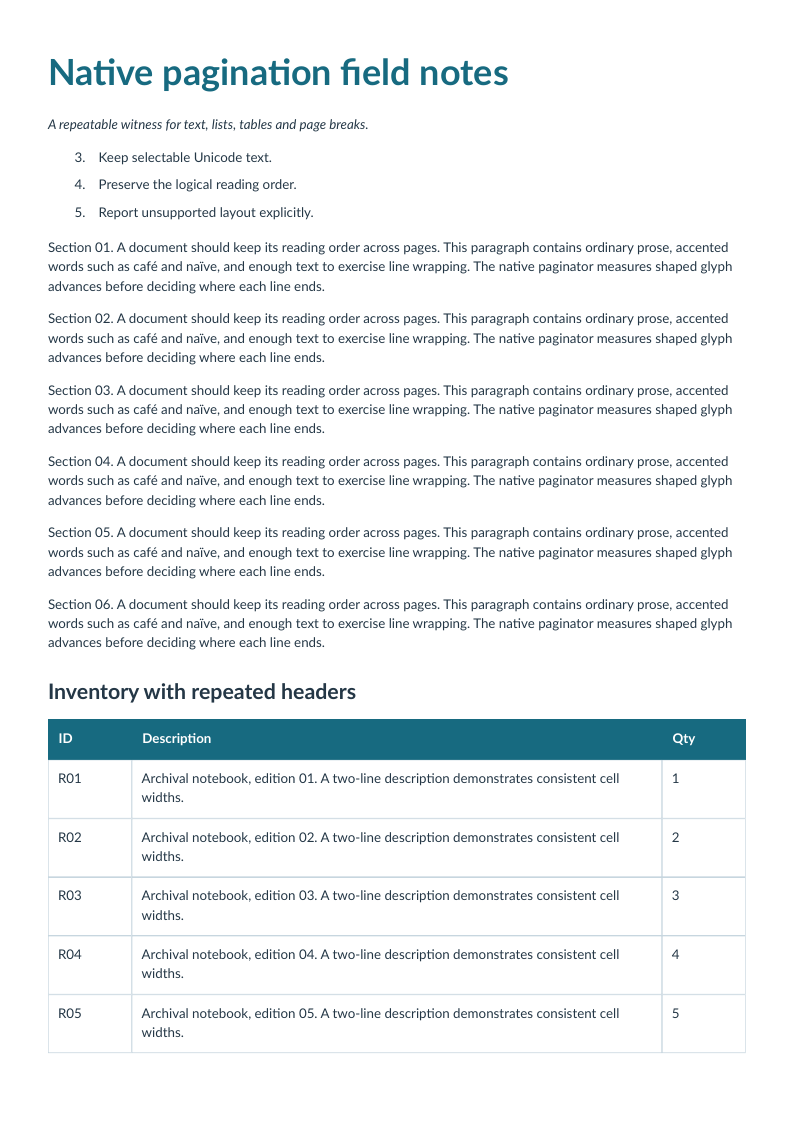
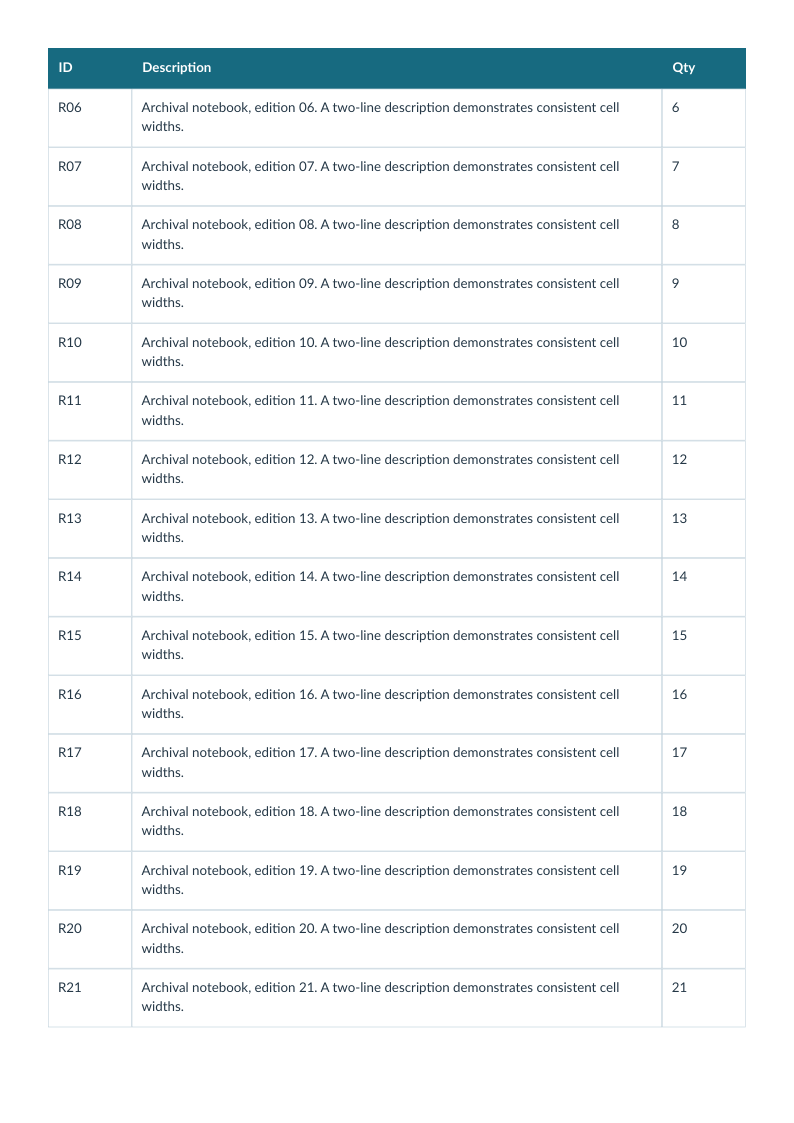
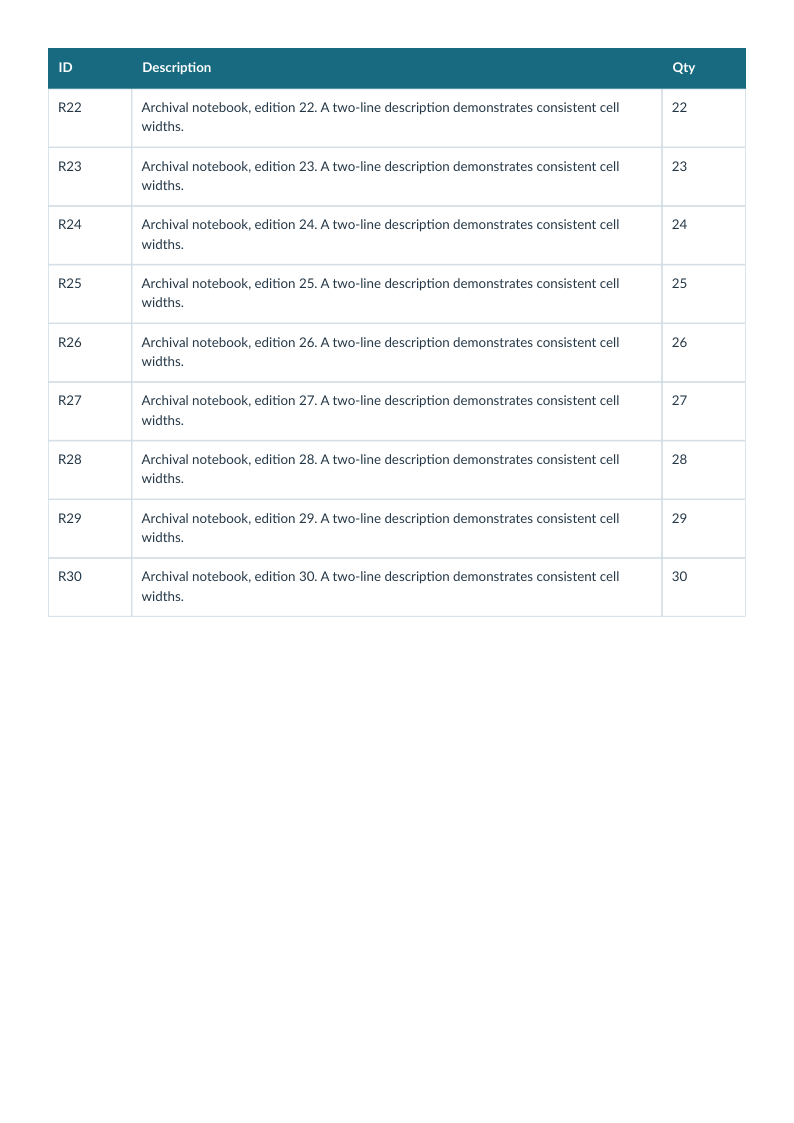
Un document de quatre pages combine paragraphes, liste numérotée, trente lignes d’inventaire et saut de page final imposé. Les lignes du tableau restent indivisibles ; les en-têtes répétés deviennent des artefacts après leur première apparition.
L’oracle vérifie les trente références, 31 éléments TR logiques en comptant l’en-tête, trois TH logiques et la conclusion sur la dernière page. Chaque page est rendue et contrôlée pour repérer coupures et pages blanches inattendues.
Source HTML · Télécharger le PDF
php -d memory_limit=512M examples/generate.php _build/examples
python tools/validate_pdf.py --directory _build/examples
Cet exemple illustre le profil documenté, sans certification d’un niveau CSS complet ni PDF/UA.
Voir le résultat PDF
Ce fichier a été généré avec le code de cette documentation. Toutes ses pages sont reproduites ci-dessous ; ouvrir le PDF pour utiliser ses liens et ses signets.

Utiliser le lecteur PDF du navigateur
Ce lecteur dépend du navigateur. Si le document ne s’affiche pas, utiliser « Ouvrir le PDF » ou « Télécharger ».
Source HTML
Lire la source HTML
<!doctype html>
<html lang="en"><head><meta charset="utf-8"><title>Native pagination field notes</title>
<style>
body { font-size: 10pt; line-height: 1.45; color: #243746; }
h1 { font-size: 27pt; color: #176a80; margin: 0 0 12pt; }
h2 { font-size: 16pt; margin: 18pt 0 8pt; }
p { margin: 0 0 10pt; orphans: 2; widows: 2; }
ul, ol { margin: 0 0 12pt; padding-left: 20pt; }
li { margin: 0 0 6pt; }
table { table-layout: fixed; width: 100%; margin: 0; }
th { background-color: #176a80; color: white; padding: 8pt; text-align: left; }
td { padding: 7pt; border: 0.5pt solid #c7d6df; }
.id { width: 12%; } .description { width: 76%; } .quantity { width: 12%; }
.closing { break-before: page; }
.note { background-color: #e7eff4; padding: 12pt; }
</style></head><body>
<h1>Native pagination field notes</h1>
<p><em>A repeatable witness for text, lists, tables and page breaks.</em></p>
<ol start="3"><li>Keep selectable Unicode text.</li><li>Preserve the logical reading order.</li><li>Report unsupported layout explicitly.</li></ol>
<p>Section 01. A document should keep its reading order across pages. This paragraph contains ordinary prose, accented words such as café and naïve, and enough text to exercise line wrapping. The native paginator measures shaped glyph advances before deciding where each line ends.</p>
<p>Section 02. A document should keep its reading order across pages. This paragraph contains ordinary prose, accented words such as café and naïve, and enough text to exercise line wrapping. The native paginator measures shaped glyph advances before deciding where each line ends.</p>
<p>Section 03. A document should keep its reading order across pages. This paragraph contains ordinary prose, accented words such as café and naïve, and enough text to exercise line wrapping. The native paginator measures shaped glyph advances before deciding where each line ends.</p>
<p>Section 04. A document should keep its reading order across pages. This paragraph contains ordinary prose, accented words such as café and naïve, and enough text to exercise line wrapping. The native paginator measures shaped glyph advances before deciding where each line ends.</p>
<p>Section 05. A document should keep its reading order across pages. This paragraph contains ordinary prose, accented words such as café and naïve, and enough text to exercise line wrapping. The native paginator measures shaped glyph advances before deciding where each line ends.</p>
<p>Section 06. A document should keep its reading order across pages. This paragraph contains ordinary prose, accented words such as café and naïve, and enough text to exercise line wrapping. The native paginator measures shaped glyph advances before deciding where each line ends.</p>
<h2>Inventory with repeated headers</h2>
<table><thead><tr><th class="id" scope="col">ID</th><th class="description" scope="col">Description</th><th class="quantity" scope="col">Qty</th></tr></thead><tbody>
<tr><td>R01</td><td>Archival notebook, edition 01. A two-line description demonstrates consistent cell widths.</td><td>1</td></tr>
<tr><td>R02</td><td>Archival notebook, edition 02. A two-line description demonstrates consistent cell widths.</td><td>2</td></tr>
<tr><td>R03</td><td>Archival notebook, edition 03. A two-line description demonstrates consistent cell widths.</td><td>3</td></tr>
<tr><td>R04</td><td>Archival notebook, edition 04. A two-line description demonstrates consistent cell widths.</td><td>4</td></tr>
<tr><td>R05</td><td>Archival notebook, edition 05. A two-line description demonstrates consistent cell widths.</td><td>5</td></tr>
<tr><td>R06</td><td>Archival notebook, edition 06. A two-line description demonstrates consistent cell widths.</td><td>6</td></tr>
<tr><td>R07</td><td>Archival notebook, edition 07. A two-line description demonstrates consistent cell widths.</td><td>7</td></tr>
<tr><td>R08</td><td>Archival notebook, edition 08. A two-line description demonstrates consistent cell widths.</td><td>8</td></tr>
<tr><td>R09</td><td>Archival notebook, edition 09. A two-line description demonstrates consistent cell widths.</td><td>9</td></tr>
<tr><td>R10</td><td>Archival notebook, edition 10. A two-line description demonstrates consistent cell widths.</td><td>10</td></tr>
<tr><td>R11</td><td>Archival notebook, edition 11. A two-line description demonstrates consistent cell widths.</td><td>11</td></tr>
<tr><td>R12</td><td>Archival notebook, edition 12. A two-line description demonstrates consistent cell widths.</td><td>12</td></tr>
<tr><td>R13</td><td>Archival notebook, edition 13. A two-line description demonstrates consistent cell widths.</td><td>13</td></tr>
<tr><td>R14</td><td>Archival notebook, edition 14. A two-line description demonstrates consistent cell widths.</td><td>14</td></tr>
<tr><td>R15</td><td>Archival notebook, edition 15. A two-line description demonstrates consistent cell widths.</td><td>15</td></tr>
<tr><td>R16</td><td>Archival notebook, edition 16. A two-line description demonstrates consistent cell widths.</td><td>16</td></tr>
<tr><td>R17</td><td>Archival notebook, edition 17. A two-line description demonstrates consistent cell widths.</td><td>17</td></tr>
<tr><td>R18</td><td>Archival notebook, edition 18. A two-line description demonstrates consistent cell widths.</td><td>18</td></tr>
<tr><td>R19</td><td>Archival notebook, edition 19. A two-line description demonstrates consistent cell widths.</td><td>19</td></tr>
<tr><td>R20</td><td>Archival notebook, edition 20. A two-line description demonstrates consistent cell widths.</td><td>20</td></tr>
<tr><td>R21</td><td>Archival notebook, edition 21. A two-line description demonstrates consistent cell widths.</td><td>21</td></tr>
<tr><td>R22</td><td>Archival notebook, edition 22. A two-line description demonstrates consistent cell widths.</td><td>22</td></tr>
<tr><td>R23</td><td>Archival notebook, edition 23. A two-line description demonstrates consistent cell widths.</td><td>23</td></tr>
<tr><td>R24</td><td>Archival notebook, edition 24. A two-line description demonstrates consistent cell widths.</td><td>24</td></tr>
<tr><td>R25</td><td>Archival notebook, edition 25. A two-line description demonstrates consistent cell widths.</td><td>25</td></tr>
<tr><td>R26</td><td>Archival notebook, edition 26. A two-line description demonstrates consistent cell widths.</td><td>26</td></tr>
<tr><td>R27</td><td>Archival notebook, edition 27. A two-line description demonstrates consistent cell widths.</td><td>27</td></tr>
<tr><td>R28</td><td>Archival notebook, edition 28. A two-line description demonstrates consistent cell widths.</td><td>28</td></tr>
<tr><td>R29</td><td>Archival notebook, edition 29. A two-line description demonstrates consistent cell widths.</td><td>29</td></tr>
<tr><td>R30</td><td>Archival notebook, edition 30. A two-line description demonstrates consistent cell widths.</td><td>30</td></tr>
</tbody></table>
<h2 class="closing">Closing note</h2>
<p class="note">This heading begins on a new page because the source requests a forced page break. The table above contains every row from R01 through R30, once in logical order.</p>
<p>End of document — all thirty inventory records are present.</p>
</body></html>
Code source complet
Code de pdftoolkit/html-to-pdf · Consulter la source au commit documenté ↗ · Source HTML au commit documenté ↗
Lire le script commenté : generate.php
<?php

declare(strict_types=1);

use PDF\HtmlToPdf\ConversionOptions;
use PDF\HtmlToPdf\Converter;
use PDF\HtmlToPdf\Font\FontFace;
use PDF\HtmlToPdf\Font\FontSet;
use PDF\HtmlToPdf\HtmlSource;
use PDF\HtmlToPdf\Resource\ImageAsset;
use PDF\HtmlToPdf\Resource\ResourceCatalog;

require dirname(__DIR__) . '/vendor/autoload.php';

// This CLI explicitly owns file access. The library receives only immutable bytes.
$destination = $argv[1] ?? dirname(__DIR__) . '/_build/examples';
if (!is_dir($destination) && !mkdir($destination, 0777, true) && !is_dir($destination)) {
    throw new RuntimeException('Cannot create the example output directory.');
}
$read = static function (string $path): string {
    $bytes = file_get_contents($path);
    if ($bytes === false) {
        throw new RuntimeException('Cannot read ' . $path);
    }

    return $bytes;
};
$fonts = new FontSet(
    regular: new FontFace($read(__DIR__ . '/assets/fonts/Lato-Regular.ttf')),
    bold: new FontFace($read(__DIR__ . '/assets/fonts/Lato-Bold.ttf')),
    italic: new FontFace($read(__DIR__ . '/assets/fonts/Lato-Italic.ttf')),
);
$images = [];
foreach (['notebook', 'lamp', 'mug'] as $name) {
    $images[$name . '.png'] = new ImageAsset($read(__DIR__ . '/assets/images/' . $name . '.png'));
}
$options = new ConversionOptions(fonts: $fonts, resources: new ResourceCatalog(images: $images));
$converter = new Converter();
$manifest = ['php' => PHP_VERSION, 'engine' => 'native-php', 'documents' => []];
foreach (['invoice', 'catalogue', 'multipage', 'css1'] as $name) {
    $started = hrtime(true);
    $html = $read(__DIR__ . '/sources/' . $name . '.html');
    $result = $converter->convert(new HtmlSource($html), $options);
    file_put_contents($destination . '/' . $name . '.pdf', $result->pdf);
    $manifest['documents'][$name] = [
        'pages' => $result->pageCount,
        'elapsedSeconds' => (hrtime(true) - $started) / 1e9,
        'peakMemoryBytes' => memory_get_peak_usage(true),
        'sourceSha256' => hash('sha256', $html),
        'pdfSha256' => hash('sha256', $result->pdf),
        'bytes' => strlen($result->pdf),
        'diagnostics' => $result->diagnostics,
    ];
    fwrite(STDOUT, $name . ': ' . $result->pageCount . ' page(s), ' . strlen($result->pdf) . " bytes\n");
}
file_put_contents($destination . '/manifest.json', json_encode($manifest, JSON_PRETTY_PRINT | JSON_UNESCAPED_UNICODE | JSON_THROW_ON_ERROR) . "\n");