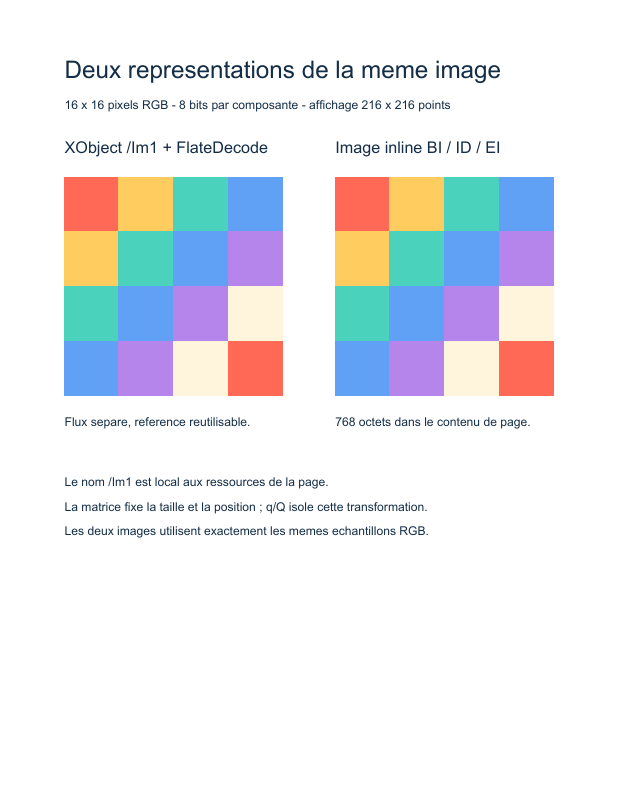
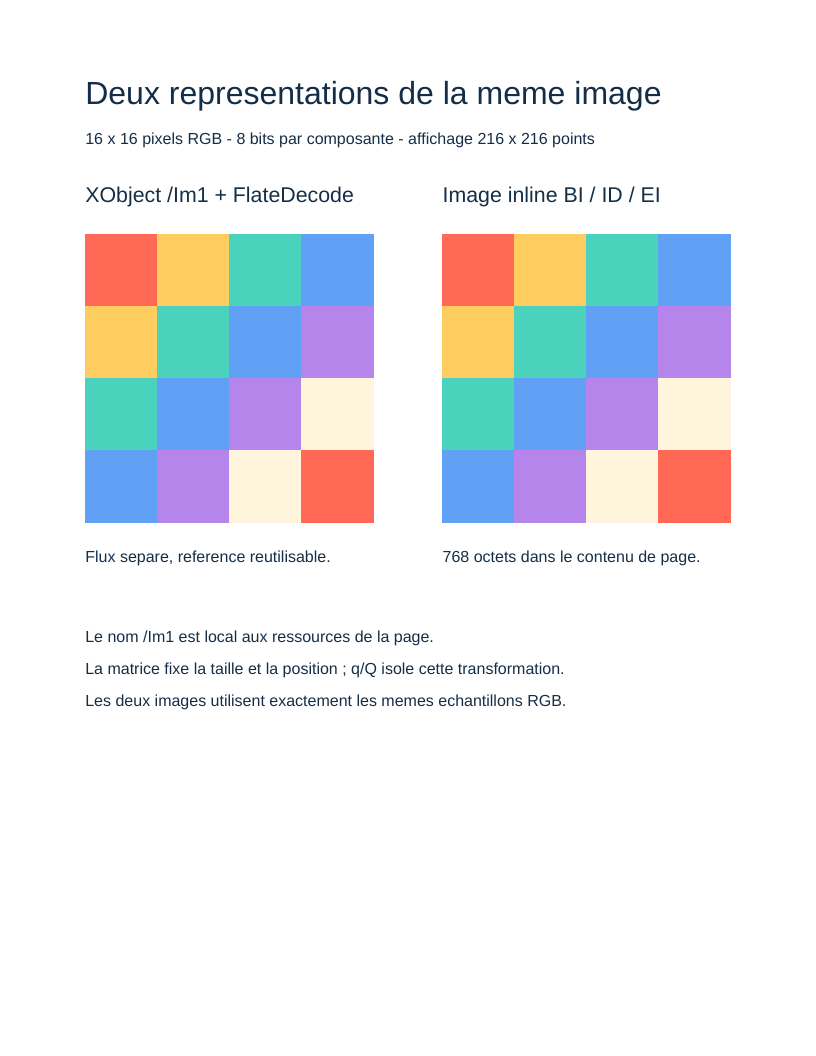
Cet exemple affiche côte à côte le même motif coloré : à gauche un XObject image compressé et référencé par la page, à droite une image inline contenue dans les instructions de dessin. Le motif de 16 × 16 pixels est entièrement produit par PHP ; aucun fichier image ni téléchargement n'est nécessaire.
Exécuter l'exemple
Depuis la racine d'un checkout du core, après composer install :
php examples/images.php images.pdf
Le chemin de sortie est facultatif ; sa valeur par défaut est examples/images.pdf. Le script complet se trouve dans examples/images.php.
1. Produire les échantillons
$pixels contient des octets RGB bruts, rangés ligne par ligne. Chaque pixel occupe trois octets : rouge, vert et bleu. Avec 16 × 16 pixels et 8 bits par composante, le contenu mesure 768 octets. La petite palette lumineuse et les blocs de quatre pixels rendent l'agrandissement facile à observer.
Ces données n'ont ni en-tête PNG ni en-tête JPEG. Le dictionnaire PDF fournit leur interprétation :
| Entrée | Objet PHP | Signification |
|---|---|---|
/Width 16 |
WidthEntry(IntegerType) |
Nombre de pixels d'une ligne. |
/Height 16 |
HeightEntry(IntegerType) |
Nombre de lignes. |
/BitsPerComponent 8 |
BitsPerComponentEntry(IntegerType) |
Une composante tient dans un octet. |
/ColorSpace /DeviceRGB |
ColorSpaceEntry(NameType) |
Chaque pixel comporte trois composantes. |
/Interpolate false |
InterpolateEntry(BooleanType) |
Demande de conserver des contours nets à l'agrandissement. |
Ces classes d'entrées sont rattachées à la table 89 de la norme. Les mêmes objets d'entrées immuables servent aux deux représentations.
2. Construire un XObject image
ImageDictionaryTable89 ajoute /Type /XObject et /Subtype /Image à la description des pixels. StreamObject associe ce dictionnaire aux données ; FlateDecode les compresse avec zlib lors de la sérialisation. Le flux écrit possède alors /Filter /FlateDecode et une /Length calculée sur les octets compressés.
Le nom du filtre décrit l'opération que le lecteur PDF applique pour retrouver les pixels. Le script fournit les pixels non compressés à StreamObject, qui effectue l'encodage correspondant.
$image = new StreamObject($pixels, $imageDictionary, new FlateDecode());

new XObject(new DictionaryType(
    new Entry(new NameType('Im1'), new IndirectReference($image)),
));
Le dictionnaire /Resources de la page relie /Im1 au flux indirect. InvokeXObject(new NameType('Im1')) produit /Im1 Do. Le même flux peut être invoqué plusieurs fois, avec des transformations différentes, sans recopier ses pixels.
3. Fixer la taille et la position
Les dimensions en pixels décrivent le contenu de l'image. L'image PDF est peinte dans le carré unité ; la matrice courante détermine sa taille sur la page.
q
216 0 0 216 64 400 cm
/Im1 Do
Q
ConcatenateMatrix applique ici une mise à l'échelle de 216 × 216 points, puis une translation vers (64, 400). Les 16 pixels sont donc agrandis. SaveGraphicsState (q) et RestoreGraphicsState (Q) encadrent la transformation pour que les autres dessins et textes conservent leurs coordonnées habituelles.
4. Insérer une image inline
InlineImage écrit une instruction composée de BI, du dictionnaire direct, de ID, des octets et de EI. Elle apparaît directement dans le flux de contenu, sans ressource /Im1 ni objet image séparé.
L'exemple transmet les 768 octets bruts et ne déclare aucun filtre pour cette image. Son dictionnaire contient les dimensions, les bits, la couleur et l'interpolation ; les entrées /Type et /Subtype utilisées par le XObject sont absentes.
Une deuxième matrice la place à (332, 400) avec la même taille. Les deux motifs doivent donc avoir le même aspect, bien que leur organisation dans le fichier soit différente.
À essayer
- Réutiliser
/Im1avec un autreInvokeXObjectet une autre matrice, pour comparer plusieurs tailles sans recréer le flux image. - Passer
/Interpolateàtrueet observer la décision d'interpolation du lecteur à fort agrandissement. - Modifier la palette ou le motif tout en gardant exactement
Width × Height × 3octets avec 8 bits par composante RGB. - Remplacer les pixels par des données JPEG déjà encodées demanderait un autre filtre et une autre construction ; une chaîne de bytes PNG complète ne peut pas être utilisée comme pixels RGB bruts.
Points à connaître
Cet exemple couvre des images opaques en /DeviceRGB, sans masque ni gestion de profils colorimétriques. Il ne fournit pas de chargeur PNG/JPEG. Les classes générées décrivent les entrées de la norme ; elles ne constituent pas un décodeur d'images.
Une image inline ne peut pas contenir une séquence binaire qui serait interprétée comme un terminateur EI ambigu. InlineImage refuse cette situation. La palette de ce tutoriel est choisie pour l'éviter ; un XObject image convient aux données arbitraires et aux images réutilisées.
Repères dans ISO 32000-1:2008 : 7.3.8 (flux), 7.4.4 (FlateDecode), 8.3.3 (transformations), 8.8 (XObjects), 8.9.5 et table 89 (dictionnaire image), 8.9.7 (images inline).
← 5. Liens · Tous les tutoriels · 7. Dégradé axial →
Voir le résultat PDF
Ce fichier a été généré avec le code de cette documentation. Toutes ses pages sont reproduites ci-dessous ; ouvrir le PDF pour utiliser ses liens et ses signets.
Utiliser le lecteur PDF du navigateur
Ce lecteur dépend du navigateur. Si le document ne s’affiche pas, utiliser « Ouvrir le PDF » ou « Télécharger ».
Code source complet
Code de roukmoute/pdf · Consulter la source au commit documenté ↗
Lire le script commenté : images.php
<?php

declare(strict_types=1);

use PDF\Document\Fonts\StandardFont;
use PDF\Document\Fonts\Type1Font;
use PDF\Document\ResourceDictionary;
use PDF\Document\Resources\Font;
use PDF\Document\Resources\XObject;
use PDF\FileStructure;
use PDF\Graphics\CoordinateSystems\Matrix;
use PDF\Specification\Dictionary\ImageDictionaryTable89;
use PDF\Specification\Dictionary\ImageDictionaryTable89\BitsPerComponentEntry;
use PDF\Specification\Dictionary\ImageDictionaryTable89\ColorSpaceEntry;
use PDF\Specification\Dictionary\ImageDictionaryTable89\HeightEntry;
use PDF\Specification\Dictionary\ImageDictionaryTable89\InterpolateEntry;
use PDF\Specification\Dictionary\ImageDictionaryTable89\SubtypeEntry;
use PDF\Specification\Dictionary\ImageDictionaryTable89\TypeEntry;
use PDF\Specification\Dictionary\ImageDictionaryTable89\WidthEntry;
use PDF\Syntax\ContentStreamsResources\ContentStreams;
use PDF\Syntax\ContentStreamsResources\Operators\BeginTextObject;
use PDF\Syntax\ContentStreamsResources\Operators\ConcatenateMatrix;
use PDF\Syntax\ContentStreamsResources\Operators\EndTextObject;
use PDF\Syntax\ContentStreamsResources\Operators\InlineImage;
use PDF\Syntax\ContentStreamsResources\Operators\InvokeXObject;
use PDF\Syntax\ContentStreamsResources\Operators\MoveTextPosition;
use PDF\Syntax\ContentStreamsResources\Operators\RestoreGraphicsState;
use PDF\Syntax\ContentStreamsResources\Operators\SaveGraphicsState;
use PDF\Syntax\ContentStreamsResources\Operators\SetNonstrokingRGBColor;
use PDF\Syntax\ContentStreamsResources\Operators\SetTextFontAndSize;
use PDF\Syntax\ContentStreamsResources\Operators\ShowText;
use PDF\Syntax\DataStructure\Rectangle;
use PDF\Syntax\DocumentStructure\DocumentCatalog;
use PDF\Syntax\DocumentStructure\PageTree\PageObject;
use PDF\Syntax\DocumentStructure\PageTree\PageTreeNode;
use PDF\Syntax\FileStructure\FileBody;
use PDF\Syntax\FileStructure\FileHeader;
use PDF\Syntax\Filters\FlateDecode;
use PDF\Syntax\Object\BooleanType;
use PDF\Syntax\Object\DictionaryObject\Entry;
use PDF\Syntax\Object\DictionaryType;
use PDF\Syntax\Object\IndirectReference;
use PDF\Syntax\Object\IntegerType;
use PDF\Syntax\Object\NameType;
use PDF\Syntax\Object\NumericType;
use PDF\Syntax\Object\StreamObject;
use PDF\Syntax\Object\StringObject\LiteralString;

require dirname(__DIR__) . '/vendor/autoload.php';

// 1. Build pixels, not a PNG file: each pixel contains three bytes
//    R, G, B. 16 × 16 × 3 = 768 bytes, arranged row by row.
//    The palette contains no ambiguous EI terminator for the inline image.
$palette = [
    [255, 105, 85],
    [255, 204, 96],
    [74, 210, 188],
    [96, 160, 245],
    [181, 133, 235],
    [255, 245, 220],
];
$pixels = '';
for ($y = 0; $y < 16; ++$y) {
    for ($x = 0; $x < 16; ++$x) {
        $colour = $palette[(intdiv($x, 4) + intdiv($y, 4)) % count($palette)];
        $pixels .= chr($colour[0]) . chr($colour[1]) . chr($colour[2]);
    }
}

// 2. Describe samples: /Width and /Height count pixels; 8 bits per
//    component give 256 values; /DeviceRGB expects three components.
//    These entries come from specification Table 89. Interpolate=false
//    preserves the pattern's edges when enlarged.
$width = new WidthEntry(new IntegerType(16));
$height = new HeightEntry(new IntegerType(16));
$bits = new BitsPerComponentEntry(new IntegerType(8));
$colourSpace = new ColorSpaceEntry(new NameType('DeviceRGB'));
$interpolate = new InterpolateEntry(new BooleanType(false));
$imageDictionary = new ImageDictionaryTable89(
    new TypeEntry(new NameType('XObject')),
    new SubtypeEntry(new NameType('Image')),
    $width,
    $height,
    $bits,
    $colourSpace,
    $interpolate,
);

// 3. The image XObject is a separate stream referenced as /Im1 in /XObject.
//    StreamObject compresses pixels with zlib, then produces /Filter
//    /FlateDecode and /Length. Original bytes remain the starting point.
$image = new StreamObject($pixels, $imageDictionary, new FlateDecode());
$helvetica = new Type1Font(StandardFont::Helvetica);
$resources = new ResourceDictionary(
    new Font(new DictionaryType(
        new Entry(new NameType('F1'), new IndirectReference($helvetica)),
    )),
    new XObject(new DictionaryType(
        new Entry(new NameType('Im1'), new IndirectReference($image)),
    )),
);

// 4. The inline image contains its dictionary and bytes directly in
//    the content stream: InlineImage writes BI, ID and EI as one instruction.
//    It has no /Type, /Subtype or entry in /XObject resources.
//    Pixels are raw here: no /Filter is declared.
$inlineImage = new InlineImage(new DictionaryType(
    $width,
    $height,
    $bits,
    $colourSpace,
    $interpolate,
), $pixels);

// 5. A PDF image occupies the unit square. cm transforms it into a
//    216 × 216 point square and translates it. The 16 × 16 pixel resolution
//    therefore does not determine page size. q/Q enclose each cm.
$contents = new StreamObject(new ContentStreams(
    new SetNonstrokingRGBColor(new NumericType(0.08), new NumericType(0.18), new NumericType(0.28)),
    new BeginTextObject(),
    new SetTextFontAndSize(new NameType('F1'), new NumericType(24)),
    new MoveTextPosition(new NumericType(64), new NumericType(714)),
    new ShowText(new LiteralString('Deux representations de la meme image')),
    new SetTextFontAndSize(new NameType('F1'), new NumericType(12)),
    new MoveTextPosition(new NumericType(0), new NumericType(-30)),
    new ShowText(new LiteralString('16 x 16 pixels RGB - 8 bits par composante - affichage 216 x 216 points')),
    new EndTextObject(),
    new BeginTextObject(),
    new SetTextFontAndSize(new NameType('F1'), new NumericType(16)),
    new MoveTextPosition(new NumericType(64), new NumericType(640)),
    new ShowText(new LiteralString('XObject /Im1 + FlateDecode')),
    new EndTextObject(),
    new SaveGraphicsState(),
    new ConcatenateMatrix(new Matrix(
        new NumericType(216),
        new NumericType(0),
        new NumericType(0),
        new NumericType(216),
        new NumericType(64),
        new NumericType(400),
    )),
    new InvokeXObject(new NameType('Im1')),
    new RestoreGraphicsState(),
    new BeginTextObject(),
    new SetTextFontAndSize(new NameType('F1'), new NumericType(16)),
    new MoveTextPosition(new NumericType(332), new NumericType(640)),
    new ShowText(new LiteralString('Image inline BI / ID / EI')),
    new EndTextObject(),
    new SaveGraphicsState(),
    new ConcatenateMatrix(new Matrix(
        new NumericType(216),
        new NumericType(0),
        new NumericType(0),
        new NumericType(216),
        new NumericType(332),
        new NumericType(400),
    )),
    $inlineImage,
    new RestoreGraphicsState(),
    new BeginTextObject(),
    new SetTextFontAndSize(new NameType('F1'), new NumericType(12)),
    new MoveTextPosition(new NumericType(64), new NumericType(370)),
    new ShowText(new LiteralString('Flux separe, reference reutilisable.')),
    new MoveTextPosition(new NumericType(268), new NumericType(0)),
    new ShowText(new LiteralString('768 octets dans le contenu de page.')),
    new MoveTextPosition(new NumericType(-268), new NumericType(-60)),
    new ShowText(new LiteralString('Le nom /Im1 est local aux ressources de la page.')),
    new MoveTextPosition(new NumericType(0), new NumericType(-24)),
    new ShowText(new LiteralString('La matrice fixe la taille et la position ; q/Q isole cette transformation.')),
    new MoveTextPosition(new NumericType(0), new NumericType(-24)),
    new ShowText(new LiteralString('Les deux images utilisent exactement les memes echantillons RGB.')),
    new EndTextObject(),
));

// 6. Connect the page, its tree and catalog; the writer discovers indirect
//    objects and assigns their numbers from this graph.
$page = new PageObject(
    new Rectangle(new NumericType(0), new NumericType(0), new NumericType(612), new NumericType(792)),
    $resources,
    $contents,
);
$pages = (new PageTreeNode())->addKid($page);
$catalog = new DocumentCatalog($pages);
$file = new FileStructure(new FileHeader('1.7'), new FileBody($catalog), new IndirectReference($catalog));
$path = $argv[1] ?? __DIR__ . '/images.pdf';
$file->writeTo($path);
echo $path . PHP_EOL;